What Causes Frizz? The Real Mechanism, and Why Frizz-Free Is a Choice
Search for help with frizz and you will be told to tame it, fight it, banish it, control it, defeat it, or slay it. One brand calls its products frizz slayers.
That vocabulary is worth stopping on before we get to any science, because it contains an assumption nobody states out loud: that frizz is an enemy, that your hair is misbehaving, and that the correct amount of it is none.
I believed that for years. I want to explain why it is wrong on the science, and then why it is also wrong as a goal.
| THE SHORT ANSWER Frizz on a humid day is not your hair asking for moisture. It is your hair taking on water from the air, swelling, and lifting its own cuticle. That is the opposite of dryness, which is why the standard advice, more water and more humectants, often makes it worse on exactly the days you notice it most. There are three real causes, and only one of them is fixable with a product. There is also a fourth thing that gets called frizz and is not frizz at all. And there is a free way to find out which one you are dealing with, further down. |
First, about the word tame
Tame is what you do to something wild. It carries the idea that your hair, left to itself, is unruly, and that your job is to subdue it into an acceptable shape.
That framing did not arrive by accident and it is not neutral. It has been pointed at textured hair specifically for a very long time, and it has done real damage to how people feel about what grows out of their own heads. There is a difference between wanting your hair to look a particular way on a particular day, which is entirely reasonable, and being taught that its natural state is a problem requiring correction.
So, this article will not tell you how to tame anything. It will explain what frizz is, what actually causes it, what genuinely reduces it when you want it reduced, and then it will leave the decision about how much you care with you, which is where it belongs.
The vocabulary matters more than it looks. If every article you read frames frizz as a battle, then a day when your hair frizzes is a day you lost. That is a miserable way to live in a body, and it is not supported by anything in the science.
What frizz actually is
Frizz is hair that does not lie in alignment with the hair around it. Individual strands stand up, stick out, or curl independently instead of falling with their neighbors, and the result reads as fuzzy or irregular.[1]
That definition is worth holding onto because of what it does not say. It says nothing about moisture, nothing about damage, and nothing about curl type. Frizz is a description of alignment, and anything that stops strands lying together produces it.
It is also not a curly-hair phenomenon. Researchers looking at how people describe frizz found two distinct things sharing one word: short strands projecting away from the body of the hair, which is what people with straight hair usually mean, and strands that will not join their neighbors into a defined wave or curl, which is what people with textured hair usually mean.[1] Straight hair frizzes. Tightly coiled hair can be entirely frizz-free. The word covers both.
The humidity mechanism, and why most advice has it backwards
Here is the single most repeated claim in frizz content, in the words of the pages currently ranking for it. Frizz is caused by a lack of moisture in the hair shaft. Dry hair goes looking for moisture, finds it in humid air, and swells. Therefore, the fix is to moisturize your hair so it stops going looking.
The first half of that describes something real. The explanation attached to it is wrong, and the wrongness matters because it produces the opposite of the correct advice.
What is actually happening
Hair holds water, and how much it holds is set overwhelmingly by the humidity of the air around it. Hair continuously exchanges water vapour with its environment, and that exchange determines the water content. The relationship was mapped in 1931 and re-measured with modern instrumentation decades later, and the two curves agree.[2][3] At low humidity hair holds a few percent of its weight in water. At high humidity it holds considerably more.[3]
Inside the fiber, keratin chains are held in shape partly by hydrogen bonds, which are weak, temporary, and easily broken by water. When water enters, those bonds break and reform in new positions, and the fiber swells.[4] Swelling pushes the cuticle scales outward, so they no longer lie flat against each other. Strands that were lying together stop lying together. That is frizz.
Notice what is doing the work. The hair is not seeking moisture out. Water is not a nutrient hair is short of. Water moves into the fiber because the air is holding a lot of it and the fiber is permeable, and the more permeable the fiber, the more readily it happens. That is why damage increases frizz: a worn cuticle is more permeable, and it is also already sitting less flat.[5]
So, the accurate sentence is this. Frizz on a humid day is caused by your hair taking on water, not by your hair lacking it.
Why that changes what you should do
If frizz were dryness, the answer would be to add water and to use ingredients that attract more of it. That is what most advice says, and humectants such as glycerin are exactly that: ingredients that pull water toward the fiber.
But if frizz is water uptake, then adding humectants on a high-humidity day is helping the process along. This is why so many people find that the leave-in that works beautifully in one season betrays them in another, and conclude they have done something wrong. They have not. They have applied a water-attracting product on a day when the air is already supplying more water than the fiber can take without swelling.
What actually helps on a humid day is the opposite move: a film that slows water getting in, and enough hold to keep strands aligned while the air works against them. That is what the products marketed as anti-humidity or humidity-blocking are doing, and it is why they work when heavier conditioning does not.
“Frizz is a curl waiting to happen”
If you came up in the curly hair world, you know this line. It belongs to Lorraine Massey, who wrote Curly Girl: The Handbook and created the Curly Girl Method, and it is probably the single most quoted sentence about frizz in existence.
The full idea was that frizz is not a hair type and not a mistake, but a curl that has not formed yet, and that it forms once the hair is properly conditioned and given the right hold. Frizz, in that model, is hair asking for moisture.
Credit where it is due, and this matters.
Massey has moved a long way toward acceptance in the years since. She has said publicly that frizz is not the enemy, that you can never be cured of frizz, and that she has come to prefer her own curls bigger and slightly haloed rather than weighted down and separated. That is a more generous position than most of the industry currently holds, and it deserves acknowledging rather than being written out of the story.
What has not changed is the mechanism.
The claim that the amount of frizz you have reflects how well conditioned your hair is, and that the difficult kind comes from a prolonged lack of moisture, is the dehydration model. And that is the part that shaped what an entire generation of us actually did every day.
Because if frizz is thirst, the logical response is water. Constantly. And that is precisely what we did.
What that belief had me doing
I followed this faithfully. Frizz meant my hair was thirsty, so I gave it water and conditioner, over and over, and then more product on top to hold the result in place.
It became an obsession, and I do not use that word loosely. The goal was perfectly defined curls with absolutely no frizz visible anywhere. Not less frizz. None. A single halo strand at the crown could ruin how I felt about my hair for the day, and I would go back and wet it again.
I was not unusual. That standard was the whole culture I was learning in, and it was reinforced by every photograph of anyone else’s wash day that I saw.
Two things eventually broke it.
The first was learning the mechanism, which reframed what I had been doing. On humid days, the days I was most desperate about frizz, I was applying more water to hair that was already taking on all the water it could from the air. I was not correcting the problem. I was contributing to it, then blaming my hair for not responding.
The second was simply living somewhere hot. If I know I am going to be out in heat and humidity, I do not think about frizz at all now. It is not a goal any more. I would rather be comfortable than manage a few strands, and honestly, most days my hair goes up in a bun, because wearing it down makes me hotter and then the sweat and the heat undo the definition anyway.
That is not defeat. It is a decision, and it took me years to understand that it was available to me.
IMAGE PLACEHOLDER, optional. If Verna has a photo of her hair in a bun on a humid day alongside a defined wash-day photo, place both here. Caption should make the point that these are two valid choices on different days, not a before and after.
Not all frizz is a problem
This is the part that almost no article about frizz will tell you, because almost every article about frizz is attached to something being sold.
Some frizz is just hair.
Your hair is made of thousands of strands of different ages and lengths. New growth is short and will not reach the ends to lie with them. Strands that broke at some point in the past are short too. Hair grows from follicles at slightly different angles, so some of it was never going to fall in the same direction as its neighbors. None of that is damage, none of it is dehydration, and no product will resolve it, because there is nothing there to resolve.
Some people actively want it.
Frizz adds volume and expansion. Plenty of people with textured hair prefer a bigger, softer, haloed shape to a tightly defined one, and that is an aesthetic preference rather than a hair-health outcome. Neither version is healthier than the other.
Some hair will frizz regardless.
There is genuine baseline variation between people in how readily the fiber takes up water, tied to curl geometry and to the lipid content of the surface layer.[6][7] Add a humid climate and some heads will produce frizz no matter what is applied to them. If that is you, no product failure has occurred and no routine has been done wrong.
So the honest framing is not how do I eliminate frizz. It is how much does frizz cost me, on this particular day, relative to what removing it would cost me. Sometimes the answer is that you want the defined version and it is worth the products and the time. Sometimes the answer is a bun and being cool. Both are correct, and only one of them is ever presented to you as an option.
The three real causes, and one thing that is not a cause
When frizz is genuinely something you want to reduce, it helps enormously to know which of these you are looking at, because they respond to completely different things.
| What it is | What it looks like | What actually helps |
| Humidity | Appears or worsens on humid days. Tracks the weather more than the routine. Worse in summer or after a move to a wetter climate. | A film-forming product that slows water uptake, plus enough hold to keep strands aligned. Fewer humectants on high-humidity days, not more. |
| Surface damage | Present regardless of weather. Concentrated at the ends. Comes with roughness, tangling, and dullness. | Conditioning at every wash, less heat and chemical processing, and time. Damaged length grows out; it does not get rebuilt. |
| Mechanical disruption | Appears after brushing, towel drying, sleeping, or touching. Often patchy and follows what you did. | Detangle with conditioner and slip rather than dry. Microfibre or a t-shirt instead of terry. Satin or silk at night. Stop touching it while it dries. |
| Not frizz: short and stray strands | A halo of short hairs, often at the crown and hairline. Present in every condition. No pattern to it. | Nothing. This is new growth, previous breakage, and normal follicle variation. It is not a fault and there is no fix. |
That last row is the one I wish someone had shown me at twenty-five. A significant proportion of what I was fighting was hair that had committed no offence.
Why curly and coily hair frizzes more
The usual explanation is that oils cannot travel down a curved shaft, so curly hair is dry, and dry hair frizzes. The first half is true and the causal chain after it is not.
Sebum genuinely does travel less easily along a curved fiber than a straight one, which is why the ends of curly and coily hair get less of it.[8] But the frizz does not follow from dryness. It follows from geometry.
Every bend in a curl is a place where cuticle scales sit less evenly against each other, which makes the surface less smooth and the fiber more permeable at that point.[6] Bends are also where a comb catches and where mechanical wear concentrates. And a curved strand has fewer opportunities to lie flat against its neighbours than a straight one does, so any strand that steps out of alignment is more visible.
Three geometric facts, no dryness required. It matters because the fix implied by the dryness story is more moisture, and the fix implied by the geometry story is less friction and better alignment. Those are different products and different habits.
The dew point test: find out what you are actually dealing with
This costs nothing, needs no products, and answers the only question that matters, which is whether your frizz is coming from the weather or from your hair.
Look up the dew point rather than the humidity percentage.
Relative humidity is relative to temperature, so seventy percent on a cold day and seventy percent on a hot day mean very different amounts of water in the air. Dew point is an absolute measure and it is what actually predicts how your hair behaves. Every weather app shows it.
Then run this:
- Pick a low dew point day, roughly below fifty degrees Fahrenheit or ten Celsius. Wash and style exactly as you normally do. Photograph your hair in daylight once it is fully dry, from the same angle, and note the dew point.
- Wait for a high dew point day, roughly above sixty-five Fahrenheit or eighteen Celsius. Same products, same amounts, same technique, same drying method. Change nothing. Photograph again, same angle, same light.
- Compare.
If the two photographs are noticeably different, your frizz is weather-driven. No product change caused that difference, so no product change will fully remove it either. What you can do is reduce it with film formers and hold on the days you want to, and accept it on the days you would rather be comfortable. That is a choice, and now you are making it with information.
If the two photographs look much the same, the weather is not your variable. Your frizz is coming from surface damage or from how the hair is being handled, and those are things you can genuinely work on.
The reason this test matters more than it looks: almost everyone who is frustrated about frizz is unknowingly running an experiment where the biggest variable, the weather, changes daily and unrecorded. You cannot evaluate a product against a moving background. This holds the background still long enough to see it.
What actually reduces frizz, when you want it reduced
On humid days, block water rather than attract it
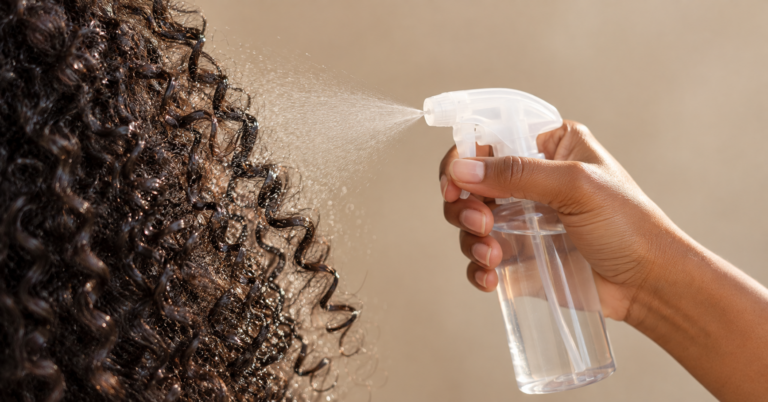
The useful products here form a film over the fiber that slows water getting in, and hold strands in alignment while the air works against them. Film-forming polymers, silicones, and gels with real hold all do this. Humectants such as glycerin do the opposite, and are better suited to dry air than wet.
These are the anti-humidity products I actually reach for when I want definition to survive a humid day:
- Ouidad Advanced Climate Control Gel. The one I use most. Built specifically for humidity rather than adapted to it.
- The Doux BLOCK PARTY Anti-Humidity Gel
- Miche Beauty Anti-Humidity Frizz-Free Strong Hold Hair Gel
None of these is a miracle and none of them makes humidity stop existing. What they do is buy you hours you would not otherwise have.
Reduce friction, everywhere
Friction between strands is what physically knocks hair out of alignment, and it is also what wears the cuticle down over time, which increases frizz permanently rather than for a day.[9]
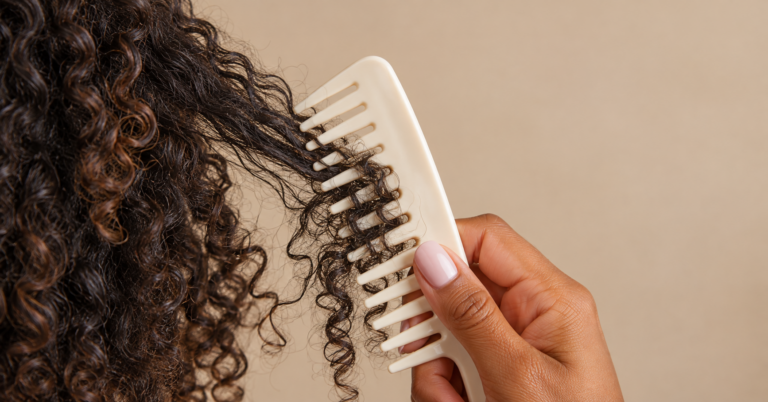
Detangle with conditioner in, never on dry unconditioned hair. Use a microfiber towel or a cotton t-shirt rather than terry. Sleep on satin or silk, or bonnet. And stop touching your hair while it dries, which is the single hardest one and probably the highest-yield.
Condition properly, for the right reason
Conditioning genuinely reduces frizz, but not because it adds moisture. Conditioning agents carry a positive charge and bind to hair, which is negatively charged and more so where it is damaged. They lie along the fiber, smooth the surface, and lower the friction between strands so hair falls together instead of catching.[9][10]
That is a real and worthwhile effect. It is just a surface effect, and it is temporary, and it is not a water-delivery system.
Protect the surface you have
Every bit of damage you prevent is frizz you will not have later. Heat protectant every time. Less bleach and less processing where you can manage it. UV protection if you are outside a lot. This is the slowest-acting advice on the page and the only kind that compounds.
Shine is the same mechanism, seen from the other side
Shine gets treated as a separate goal from frizz, with its own products. It is not separate. It is the same physics viewed differently.
Light reflects off hair in an organised way only when the surfaces it hits are smooth and pointing the same direction. A flat, intact cuticle on strands lying in alignment produces a coherent reflection, which reads as shine. A lifted or worn cuticle on strands going in different directions scatters that light in all directions, which reads as dull.
So frizz and dullness are one problem with two names. Anything that flattens the surface and aligns the strands improves both at once, which is why a conditioner improves shine, why an oil or serum improves shine, and why no amount of shine product will help hair that is standing in every direction.
It also explains the thing people find confusing about texture: tightly curled hair reflects less light than straight hair even when both are in perfect condition, because the surface is curved and constantly changing angle. That is not dullness and it is not a health signal. It is geometry, and it is worth knowing so you stop chasing a shine level your hair shape does not produce.
One consequence worth stating: if a product promises shine and your hair is significantly damaged, it is going to underdeliver, because the surface it needs to reflect off is not there. Serums and oils will help by filling and smoothing. They cannot rebuild a cuticle.
How this looks on straight, wavy, curly, and coily hair
Same mechanism throughout. What differs is how frizz presents and which cause is most likely.
Straight and fine hair
Frizz shows as short strands projecting away from the length, flyaways at the part and crown, and a halo in dry winter air where static contributes as well. Fine hair is overloaded easily, so heavy anti-frizz products often trade frizz for limpness. Start with the lightest thing that works, and treat static and humidity frizz as separate problems: static is a dry-air problem and conditioning helps it, humidity frizz is a wet-air problem and film formers help it.
Wavy hair
Frizz shows as a pattern that will not commit, halo frizz around the crown, and sections behaving differently from each other. Wavy hair sits in the hardest position, because it needs enough product to encourage alignment and is heavy-handed with product faster than any other texture. This is where the dew point test pays off most, because wavy readers churn through products trying to solve what is actually a weather problem.
Curly hair
Frizz shows as loss of definition and a halo through the lengths, plus strands escaping their clumps. Curly hair is where the frizz-free standard has done the most cultural damage, and where the largest share of what gets called frizz is actually short strands and normal variation. Run the test, and look honestly at how much of what you are seeing is hair that was never going to lie flat.
Coily hair
Frizz shows as expansion and a soft outline rather than as individual escaped strands. Coily hair has the most bends per inch, so it has the most points where scales sit unevenly and the most places friction concentrates, which is why mechanical disruption is usually the biggest lever here. Protective styling works partly because it stops the strands being handled at all. And because coily hair is the shape that gets called unruly the most often, this is where the vocabulary at the top of this article does the most harm.
Frequently asked questions
Does frizz always mean my hair is damaged?
No. Damage increases frizz, because a worn cuticle is more permeable and already sits less flat.[5] But perfectly healthy hair frizzes in humid air, and short strands and new growth produce frizz in any condition. Frizz is a signal worth reading rather than a verdict.
Why does my hair frizz more in summer?
Because there is more water in the air and your hair takes it up.[2][3] The routine did not stop working; the background changed. This is also why a product that was excellent in one climate can disappoint after a move, and it is not a sign you chose badly.
Should I use glycerin or avoid it?
Depends on the air. Glycerin is a humectant, meaning it attracts water. In dry air that can help hair feel more pliable. In very humid air it is pulling in more of what is already causing the swelling. That is the honest version of the dew point advice that circulates in the curly community, minus the rigid numeric rules, which are more precise than the evidence supports.
Does a cold rinse close the cuticle and stop frizz?
No. Cuticles do not open and close like doors. They lie flat, or they are lifted, and lifted means either swollen with water or damaged. A cold rinse does not close anything. If your hair feels smoother after conditioning, that is the conditioning agents on the surface doing their job.
Is frizz just curly hair that has not formed yet?
Sometimes, and that is what makes the idea so sticky. A strand that is not clumped with its neighbours can often be encouraged to join them with the right product and technique. But plenty of frizz is short strands, new growth, or hair swollen by humid air, and none of that becomes a curl no matter what you apply. Treating every frizzy strand as a curl waiting to happen sets a standard your hair cannot always meet.
Will cutting my hair reduce frizz?
It removes the most damaged length, which is usually the frizziest, so yes in that limited sense. It does not change how your hair responds to humidity, and it does not stop new growth producing a halo.
Do I need a different product for every season?
Not a different product, necessarily, but expect the same product to perform differently, and consider adjusting how much humectant you are applying as the dew point moves. Judging a product without noting the conditions is how people conclude a good product stopped working.
Where to go next
Understanding the mechanism tells you what you are dealing with. Working out what to do about it on your specific head, in your specific climate, is a system rather than a single article.
I am building a set of guides that do exactly that, for curly, straight, and gray hair. They are not out yet, but they are coming.
Let your hair be your guide.
Verna
References
1. Marsh, J., Gray, J., & Tosti, A. (2015). Healthy Hair. Springer Cham.
2. Chamberlain, N., & Speakman, J. B. (1931). Uber Hysteresiserscheinungen in der Wasseraufnahme des Menschenhaares. Zeitschrift fur Elektrochemie, 37, 374.
3. Evans, T. A. (2012). Adsorption properties of hair. In T. Evans & R. Wickett (Eds.), Practical Modern Hair Science (pp. 333-365). Allured Business Media.
4. Robbins, C. R. (2012). Chemical and Physical Behavior of Human Hair (5th ed.). Springer.
5. Hessefort, Y. Z., Holland, B. T., & Cloud, R. W. (2008). True porosity measurement of hair: a new way to study hair damage mechanisms. Journal of Cosmetic Science, 59(4), 303-315.
6. Cloete, E., Khumalo, N. P., & Ngoepe, M. N. (2019). The what, why and how of curly hair: a review. Proceedings of the Royal Society A, 475(2231), 20190516.
7. Coderch, L., Sabatier, L., Pasini, I., Alonso, C., Marti, M., & Baghdadli, N. (2025). Role of lipids in water permeation of different curl pattern hair types. Cosmetics, 12(5), 193.
8. Keis, K., Persaud, D., Kamath, Y. K., & Rele, A. S. (2005). Investigation of penetration abilities of various oils into human hair fibers. Journal of Cosmetic Science, 56(5), 283-295.
9. Weiand, E., Rodriguez-Ropero, F., Roiter, Y., Angioletti-Uberti, S., Dini, D., & Ewen, J. P. (2025). Understanding and controlling the friction of human hair. Advances in Colloid and Interface Science, 345, 103580.
10. Yu, Y., Yang, W., Wang, B., & Meyers, M. A. (2017). Structure and mechanical behavior of human hair. Materials Science and Engineering: C, 73, 152-163.