Your Hair Isn’t Dry, It’s Worn: What Friction Actually Does to Your Hair
When hair feels rough, snaps easily, and will not behave, the first instinct is almost always to reach for something. A richer conditioner, a deeper mask, a better oil.
Sometimes that is right. Very often it is not, because the problem is not what your hair is missing. It is what has been happening to it, dozens of times a day, in moments so small that none of them ever registered as damage.
| THE SHORT ANSWER Friction is the most underrated cause of hair damage there is. Every time strands rub against each other, or against a comb, a towel, a pillowcase, or a coat collar, the cuticle wears down slightly. No single instance matters. The accumulation is what leaves hair rough, dull, tangly, and prone to snapping. Two things make it dramatically worse: doing it while your hair is wet, and doing it without any conditioning product on the strand. Almost everything in this article follows from those two facts. |
Why Strands Fight Each Other After You Wash Them
Start with the thing that explains most of it, because it is genuinely counterintuitive.
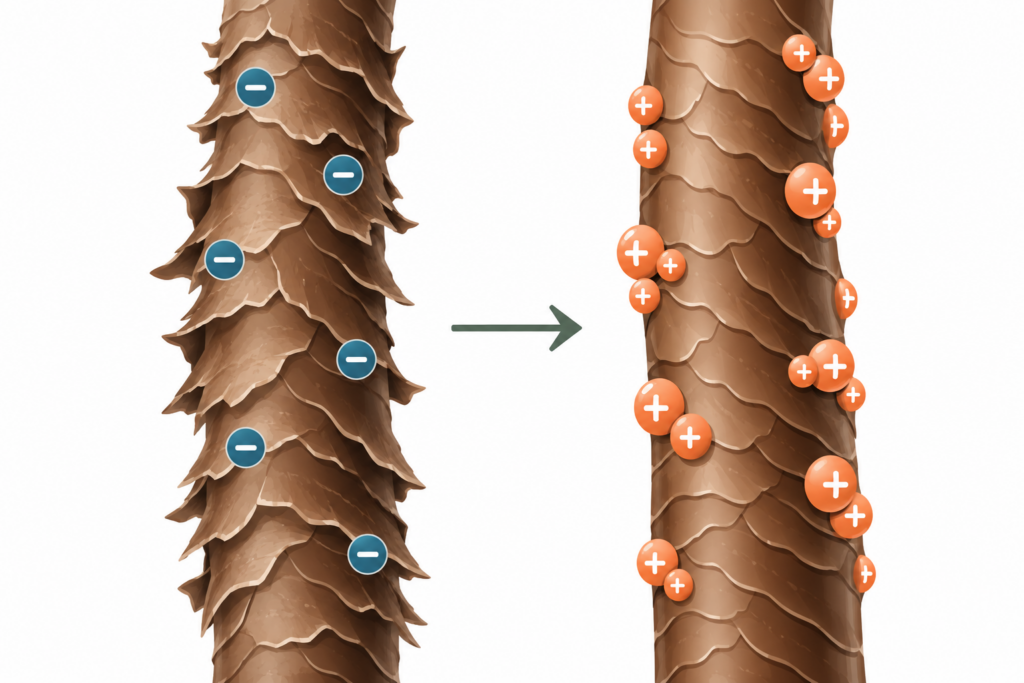
Hair carries a negative electrical charge along its surface, and shampoo makes that worse. Most cleansing surfactants are themselves negatively charged, so a wash leaves the fiber more negatively charged than it started.[1]
Like charges repel. So immediately after shampooing, your strands are actively pushing away from each other, which drives them into contact and generates friction between fibers. That friction is what makes freshly washed, unconditioned hair feel coarse, tangle instantly, and snap when you try to get a comb through it.
This is what conditioner is actually for, and it is not what the marketing says. Conditioning agents carry a positive charge, so they are drawn to the negatively charged fiber and deposit onto it, particularly onto damaged areas where the charge is strongest. That neutralises the repulsion and lays a lubricating layer along the strand. The result is less friction, easier combing, and measurably less breakage.[1][2]
Not moisture. Friction reduction. That is the mechanism.
What Combing Actually Does, Measured
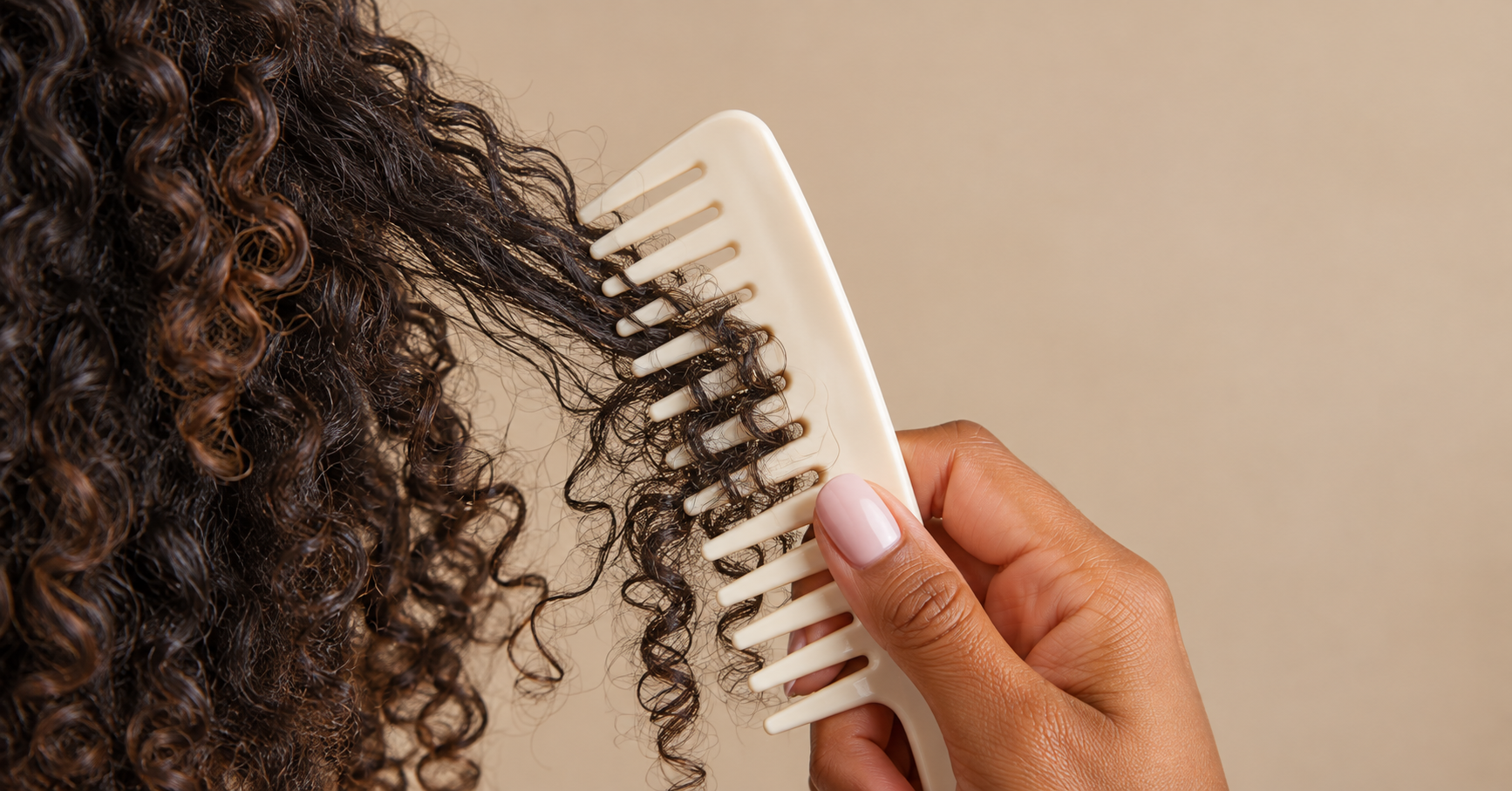
Combing and brushing are not neutral acts of tidying. Every pass applies force, stretches the fiber to some degree, and drags hard material across a surface built of overlapping scales.[1]
The documented result is that cuticle scales gradually wear down, chip, lift, and detach. That is the main long-term effect of combing and brushing: not a dramatic single injury, but the slow removal of the layer that protects the cortex underneath. As the cuticle goes, hair feels rougher, looks duller, and has less protection over the part of the fiber that actually carries its strength.
The most useful demonstration of this compares hair brushed seven hundred times wet against hair brushed seven hundred times wet with conditioner on it. The unconditioned sample shows a raised, chipped, visibly wrecked surface. The conditioned sample, after the same seven hundred strokes, is still smooth.
Same number of strokes. Same wet state. The only difference is whether anything was on the hair to reduce the friction, and that single variable is the difference between a damaged surface and an intact one.
Wet Hair Is a Different Material
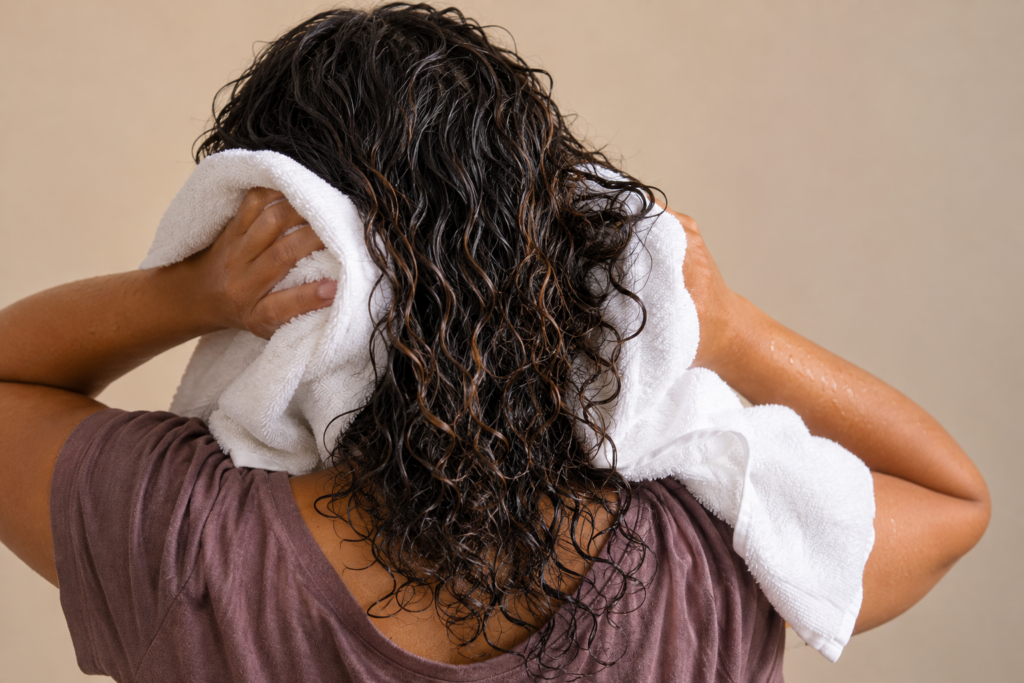
Everything above gets substantially worse when hair is wet, and this is the single highest-value thing in the article.
Water acts as a plasticizer inside the fiber. It works its way into the keratin structure, loosens the hydrogen bonds holding it in shape, and lowers both the stiffness of the fiber and the stress at which it fractures.[3] Wet hair stretches further and breaks more easily. Every hair type, from straight through tightly coiled, is weaker wet.
There is a second effect that matters just as much and gets almost no attention. When hair takes on water, the inner cuticle layers swell while the outermost layers stay comparatively rigid. That mismatch lifts cuticle scales away from the surface. And the lifting is made worse by movement and stretching, meaning the very act of handling wet hair increases the damage that handling causes.
So combing wet hair is not simply combing hair that happens to be damp. It is combing a weaker fiber whose protective scales are already standing up, with a tool designed to drag across them.
The Habit I Am Still Working On
I want to be honest here rather than write this as though I have it solved, because I do not.
My worst habit is rushing to detangle my hair while it is wet. I know exactly what the science says. I use plenty of conditioner for slip, and I use the FHI Heat UNbrush, which after a lot of trial and error is the detangling tool that works best on my 3C hair. None of that is the problem.
The problem is speed. I am always in a hurry, and when I rush I pull out more hair than I need to. Every single time. It is a hard habit to break and I am getting better at it, but slowly, and I still catch myself.
I include that partly because it is true and partly because I think the honest version is more useful than a list of rules from someone claiming to follow all of them. The tool was never my issue. The pace was.
A Note on Brushes, Since I Just Named One
Curly hair spaces treat brushes as more or less forbidden, and I understand why, but I think the rule is too blunt. A detangling brush designed to work through wet, conditioned hair is not the same object as a styling brush dragged through dry curls, and using one is not a betrayal of anything.
There is a genuinely useful rule of thumb from the formulator side of this: if the brush is soft, then a comb is the more damaging of the two, and if the brush is stiff, then the brush is more damaging. The question is not brush versus comb as a category. It is how much force the tool concentrates on the fiber, and how much lubrication is there when it does.
What I Changed, and What Actually Made a Difference
Some of these were small and some of them mattered enormously, and it was not always the ones I expected.
Switching my pillowcase from cotton to satin.
This was the biggest single change I made early in my healthy hair journey. You spend seven or eight hours a night moving your head against a surface, and cotton grips. Satin lets hair slide. There is no product in this article that does more for less effort.
Getting rid of cotton towels.
I dry my hair with an old t-shirt now, or a t-shirt style hair towel. Terry cloth is essentially a friction machine: thousands of loops catching thousands of strands, applied to hair at its most fragile point, when it is soaking wet.
Changing what I tie my hair up with.
I went from regular elastics to satin hair ties, and now to Teleties. Ordinary elastics grip and pull at one concentrated point on the strand.
Stopping the tight ponytail.
This one is not really about friction, it is about tension, and it is the one I would most want people to hear. I used to pull my hair back extremely tight into ponytails and buns, and I lost a lot of hair doing it. Sustained pulling at the follicle causes hair loss, and unlike a worn cuticle, that damage can become permanent if it goes on long enough. My buns are loose now, and that was not a cosmetic preference, it was a correction.
The Two Things Curly Readers Underestimate Most
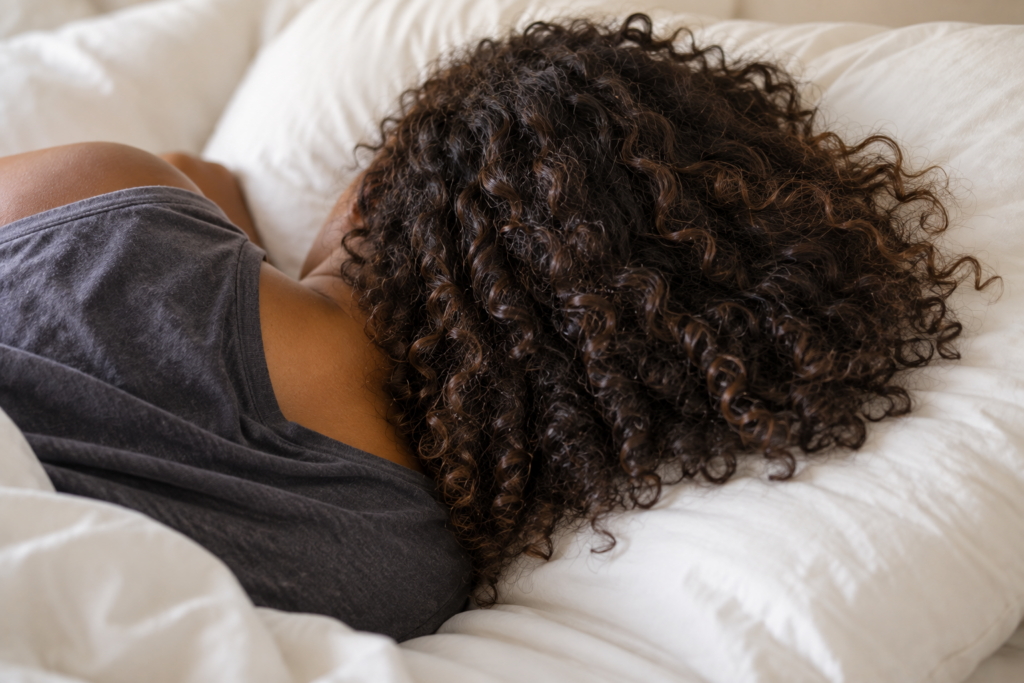
If I had to pick the two habits that do the most damage while feeling the most harmless, it would be these.
One: combing or brushing while wet.
It feels sensible. Hair is easier to get through when wet, the tangles come out with less resistance, and it seems like the gentler option. It is the opposite. The fiber is weaker, the scales are lifted, and you are working on it at exactly the wrong moment. If you must detangle wet, and most curly routines require it, then there must be a conditioning product on the hair (this one is my absolute favorite), and you must go slowly. That is what the seven hundred stroke comparison is really telling you.
Two: going to bed with wet hair.
This is the one almost nobody counts as damage, and I did it constantly early on. You are asking a weakened fiber with lifted cuticles to be pressed and dragged against a surface for hours while you move in your sleep. That is a friction event running the whole night.
It also contributed directly to my own hygral fatigue, because it kept my hair saturated for hours at a stretch on top of everything else I was doing.
There is a scalp consideration too. A damp scalp for hours favours the yeast that lives there naturally, and overgrowth of it is what produces irritation, itch, and flaking in a large share of the population.
If you genuinely cannot dry before bed, the harm reduction is straightforward: get a conditioning product on the hair so the friction is lower while you move, and tie it up loosely rather than leaving it loose across the pillow. If you can dry it, use a low heat setting and a heat protectant.
The Friction Count
Here is the exercise that makes this real, because the mechanism is easy to nod along to and almost impossible to act on until you see your own numbers.
For one ordinary day, keep a tally. Every time your hair experiences friction, mark it. Not the big things. All of them.
- Every pass of a comb or brush, counted separately rather than as one detangling session
- Towel drying, and roughly how vigorous it was
- Every time you put it up, take it down, or adjust it
- Every time you touch it, push it back, or run your fingers through it while it dries
- A coat collar, a scarf, a car headrest, a backpack strap, a hood
- The pillow, which is a single entry covering seven or eight hours
Two things usually come out of this, and they are both useful.
The total is far higher than people expect. And most of the entries have nothing to do with a brush at all.
That matters because the entire internet answers hair breakage with a product recommendation, usually a better brush. Your brush is one line on a list of twenty. If you fix only that line, you have addressed maybe five percent of what is actually happening to your hair.
Once you have the list, do not try to eliminate everything. Pick the three highest-frequency entries and reduce those. For most people that is the pillow, the towel, and the wet detangling pace, which is exactly where my own changes ended up landing, though I got there by accident over years rather than by counting.
What Actually Reduces Friction Damage
In rough order of how much difference they make for the effort involved.
- Never comb or brush dry, unconditioned hair. If you are doing a quick touch-up on dry hair, put something on it first, even a small amount of oil. This is the single most transferable rule in the article.
- Condition after every wash, before you detangle, not after. The point of the conditioner is to be present while the friction happens.[1][2]
- Slow down. There is no product that compensates for speed. This is my own weak point and I am not going to pretend otherwise.
- Handle wet hair as little as you can, and never leave it wet overnight if you can avoid it.[3]
- Detangle from the ends upward, in sections, with patience at each tangle rather than force.
- Be most careful with your ends. Combing damage increases the closer you get to them, and they are also the oldest hair on your head with the most accumulated wear. Condition them well and treat them differently from your roots.
- Satin or silk at night, either a pillowcase or a wrap.
- Microfibre or a t-shirt rather than terry cloth.
- Loose ties, and loose styles. Tension is a separate problem from friction and a more serious one.
On Scalp Brushes
Worth a specific note, since they are heavily marketed and the claims outrun the evidence.
The circular motion that scalp brushes are used with creates exactly the entanglement between fibers that causes breakage, and it does it at the roots where the hair is newest. Your scalp is also skin: try those same vigorous circles on your face and see how it feels.
On the claims: there is no good evidence that scalp brushing stimulates hair growth. The thing that treats dandruff is an anti-dandruff shampoo. And if the goal is removing oil and product buildup, shampoo distributed evenly with your fingers does that job.
If you like using one and it works for you, keep it. Use it gently and skip the harsh circular motions.
How This Differs Across Straight, Wavy, Curly, and Coily Hair
The mechanism is identical. What changes is how much friction the shape generates and where it concentrates.
Straight hair
Fewest points of contact between strands, so less inter-fiber friction overall, and sebum travels down easily to lubricate the length. Damage concentrates at the ends and often shows as splitting rather than mid-shaft snapping. Fine straight hair is the most affected by tight elastics.
Wavy hair
Enough bend to catch and tangle, not enough natural clumping to protect the strands from each other. Halo breakage at the crown is common, and this is the texture where over-brushing does the most visible damage to the pattern itself.
Curly hair
Every bend is a place where strands catch on each other and where a comb concentrates force. Single strand knots and webbing between strands are friction signatures rather than mysteries. Curlier fibers also break preferentially at the bends, where stress concentrates.[4][5]
Coily hair
The most bends per inch, therefore the most contact points, the most tangling, and the greatest mechanical vulnerability. Sebum also has the hardest journey down the shaft, so the ends get the least natural lubrication exactly where combing damage is highest. This is why low-manipulation and protective styling do more for coily hair than any product does, and why the tension warning above matters most here.
Frequently Asked Questions
Is Wet Hair Really More Fragile?
Yes, and it is not a small effect. Water loosens the bonds holding the fiber in shape, which lowers its stiffness and the stress at which it fractures.[3] It also swells the inner cuticle layers while the outer ones stay rigid, which lifts the scales. Every hair type is weaker wet.
Why Does My Hair Stick Together or Web Between Strands?
Webbing, where strands stick and mesh together rather than falling separately, is usually a friction and cuticle-condition signature. Worn, lifted cuticle scales catch on each other instead of sliding past. It is often read as a product problem, and it is more often a surface-condition problem, so the useful response is better lubrication and gentler handling rather than a different styler.
Should I Detangle Wet or Dry?
For curly and coily hair, wet with plenty of conditioner is usually the practical answer, because dry detangling on those textures does more harm. The non-negotiable part is not the state of the hair, it is whether there is a conditioning product on it while you work and how much force you are using.
Are Brushes Bad for Curly Hair?
Too blunt a rule. A detangling brush used on wet, well-conditioned hair is a different proposition from a stiff styling brush dragged through dry curls. The useful guideline from the formulation side is that if a brush is soft, a comb is the more damaging option, and if it is stiff, the brush is. Judge the tool by how much force it concentrates, not by its category.
Does Sleeping With Wet Hair Actually Cause Damage?
Yes. You are combining a weakened fiber, lifted cuticle scales, and hours of movement against a surface. If you cannot avoid it, put a conditioning product on the hair to lower the friction and tie it up loosely rather than leaving it loose. There is also a scalp argument, since hours of dampness favour the yeast that causes irritation and flaking.
Can Friction Damage Be Reversed?
No. Cuticle that has worn away does not grow back, and no product rebuilds it. What conditioning agents do is deposit on the surface, fill gaps, and lower the friction going forward, which genuinely improves how hair looks, feels, and behaves. The permanent fix is the hair you grow from here, protected better than the last lot was.
Is a Tight Ponytail Really That Bad?
Sustained tension on the follicle is a different and more serious problem than surface friction, because prolonged pulling can cause hair loss that becomes permanent if it continues long enough. This is worth taking seriously if you wear tight styles regularly. Loose is not just more comfortable, it is the point.[6]
Where to Go Next
Knowing friction is the problem is the shift. Working out which of your own habits are doing the most, and changing them in an order you can actually sustain, is a system.
I am building a set of guides that do exactly that, for curly, straight, and gray hair. They are not out yet, but they are coming.
Let your hair be your guide.
Verna
References
1. Robbins, C. R. (2012). Chemical and Physical Behavior of Human Hair (5th ed.). Springer.
2. Weiand, E., Rodriguez-Ropero, F., Roiter, Y., Angioletti-Uberti, S., Dini, D., & Ewen, J. P. (2025). Understanding and controlling the friction of human hair. Advances in Colloid and Interface Science, 345, 103580.
3. Yu, Y., Yang, W., Wang, B., & Meyers, M. A. (2017). Structure and mechanical behavior of human hair. Materials Science and Engineering: C, 73, 152-163.
4. Camacho-Bragado, G., Balooch, G., Dixon-Parks, F., Porter, C., & Bryant, H. (2015). Understanding breakage in curly hair. British Journal of Dermatology, 173, 10-16.
5. Cloete, E., Khumalo, N. P., & Ngoepe, M. N. (2019). The what, why and how of curly hair: a review. Proceedings of the Royal Society A, 475(2231), 20190516. 6. Billero, V., & Miteva, M. (2018). Traction alopecia: the root of the problem. Clinical, Cosmetic and Investigational Dermat