Hair Porosity, Explained: What It Actually Measures and How to Read Your Own Hair
If you have ever been told you have high porosity hair and handed a list of rules to follow, this article is going to complicate that in a useful way.
Porosity is real. It is measurable. It matters. But it is not the thing most of the internet says it is, and the tests you have been given cannot actually tell you what you were told they tell you. That gap between what porosity is and how it gets taught is why so many people follow a porosity routine faithfully for a year and end up with hair that is no better, or worse.
This article covers what porosity genuinely measures, why every at-home test struggles, why your roots and your ends behave like two different heads of hair, and what to observe on your own head instead. It applies to straight, wavy, curly, and coily hair, because the underlying fiber is the same in all four. Only the shape differs.
| THE SHORT ANSWER Porosity is a reading of how worn your cuticle is. In practice it is a damage measurement, not a hair type, and it is not one number for your whole head. Your roots are less porous than your ends, and the gap widens with every year of length. Nothing you can do at home will give you a porosity figure, and you do not need one. What you need is a map of where your own damage sits, and there is a free way to get one further down this page. |
What is hair porosity?
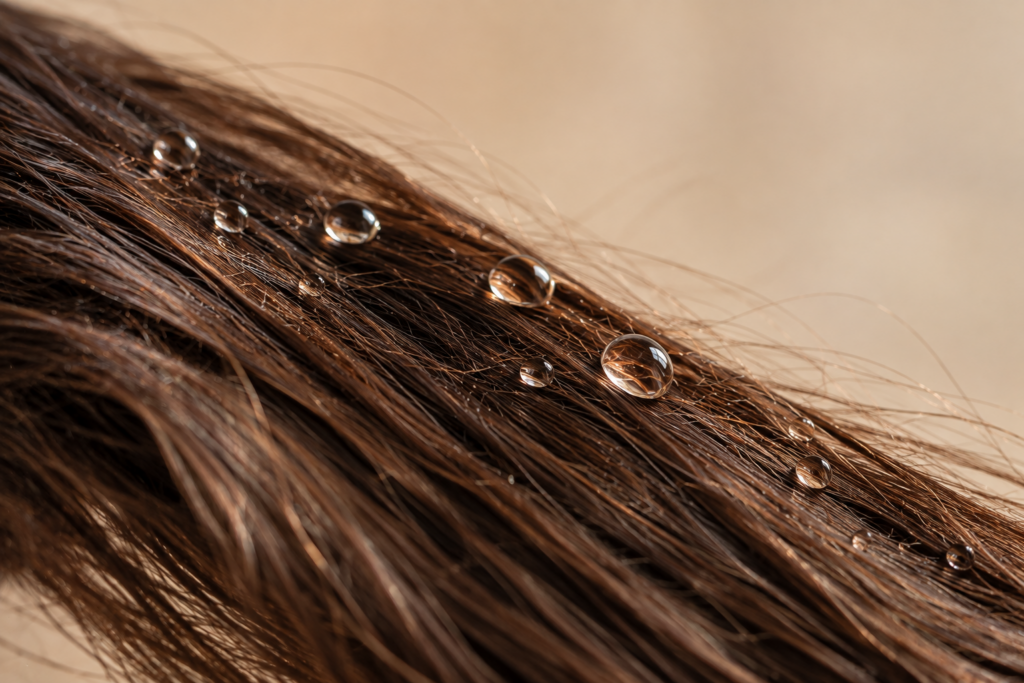
Porosity describes how readily water and other ingredients move into and out of the hair fiber. The word comes from pore, and in a hair context it refers to the size, volume, and density of microscopic openings on and within the strand.[1]
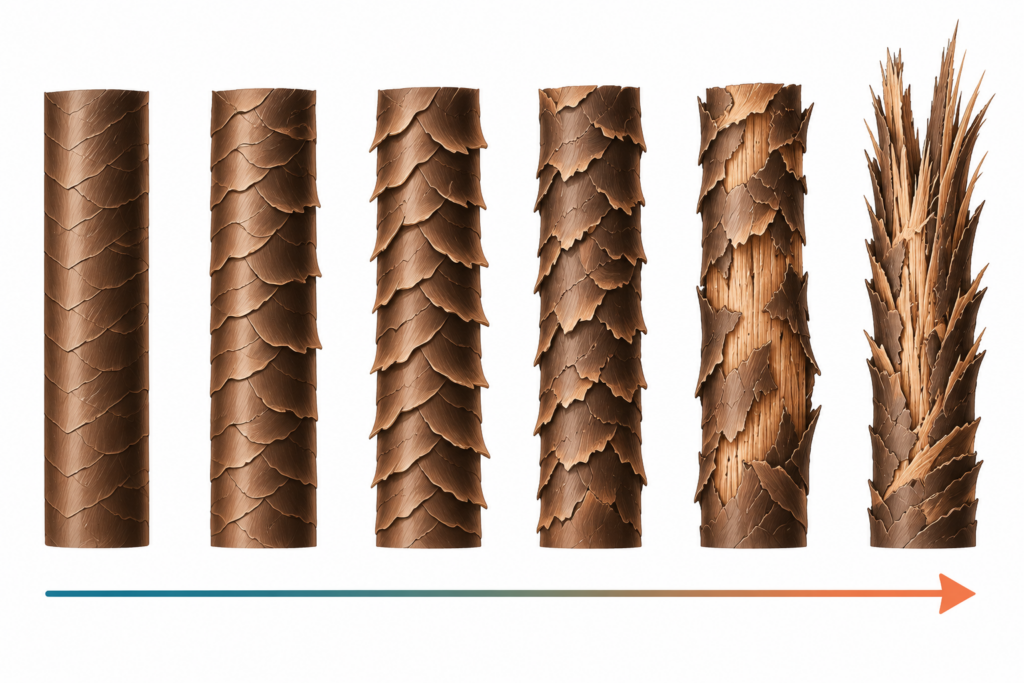
Those openings are governed mainly by the cuticle, the outermost layer of the hair, made of flat overlapping cells arranged something like shingles on a roof. When those cells lie flat and intact, the surface is smooth and water is largely kept out. When they are cracked, worn, lifted, or missing, water moves in far more easily.[1]
This is not just a description. It is measurable. When researchers put hair through gas sorption analysis, which measures total pore volume and surface area directly, bleaching nearly triples the surface area of the fiber within the first minute of processing, because the number of pores rises so sharply.[2] Porosity, measured properly, is a damage number.
Here is the part that reframes everything. Healthy hair is water repellent by design. The outermost surface of the fiber carries a thin fatty layer that repels liquid water. That is not a flaw to be overcome. It is a feature. It helps hair dry, it reduces friction between strands so hair combs more easily, and it protects the inner structure that gives hair its strength.[1]
So when a strand takes on water fast, that is not a special talent. It is a sign that the water repellent surface has been compromised.
Which leads to the definition this site uses:
Porosity is, for almost everyone asking the question, a measure of cuticle damage. More porous means more damaged.
The honest qualifier most posts skip
There is a smaller, real effect underneath the damage signal, and it is worth stating plainly rather than pretending the picture is tidier than it is. Hair that has never been processed does show some baseline variation in how readily water moves through it, tied to curl geometry, cuticle thickness, and the lipid content of the surface layer.[3][4] Tighter curl patterns tend to sit slightly higher on that baseline, because every bend is a place where cuticle scales sit less evenly.[3]
That effect is genuine and it is also small next to what bleach, heat, and years of combing do. It is not a reason to sort undamaged hair into porosity types, because the research is nowhere near the point of telling you what to buy on the strength of it. But you should know it exists, because anyone who tells you porosity is one hundred percent damage and nothing else is rounding off in the other direction.
Porosity is not a hair type, it is a reading on a spectrum
Almost every porosity article online sorts readers into three fixed categories: low, medium, high. Pick your box, then follow the rules for that box. It is a satisfying structure. It is also the wrong shape for what is actually happening.
Damage is cumulative and continuous. A strand does not arrive in one of three states. It sits somewhere on a spectrum that shifts over time, and it moves in one direction more easily than the other. Bleach, permanent color, relaxers, perms, heat styling, UV exposure, hard mechanical handling: each one pushes hair further along.[2][5]
This also means the two ends of the spectrum are not neutral alternatives to each other. Low porosity is not a condition to fix. It means the cuticle is lying flat and doing its job. There is nothing broken there. High porosity is not a personality trait to accommodate. It means the fiber is damaged.
Why the float test cannot tell you your porosity
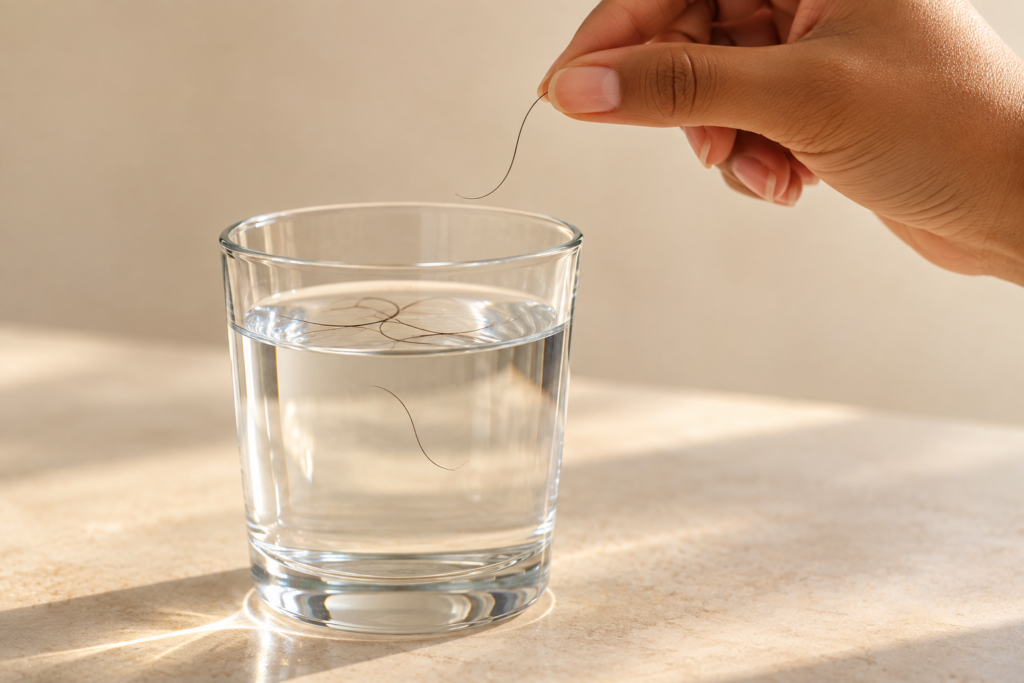
The float test asks you to drop a strand in a glass of water and read the result by where it settles. It is the most recommended porosity test online. It is also close to unusable, for reasons that are worth understanding rather than just accepting.
The physics does not do what the test assumes.
A human hair is extraordinarily light. Water has enough surface tension to hold objects far heavier than a single strand on its surface film. So most clean, dry strands sit on top at first regardless of how damaged they are. What you are watching in that first minute is surface tension, not absorption. Wait long enough and essentially all hair sinks, and the test has no agreed stopping point at which to read the answer.
Surface chemistry swamps the signal.
What actually determines how water interacts with a strand is what is on the surface of that strand. A trace of silicone from your last conditioner, a film of oil from a leave in, residual minerals from hard water: any of these changes the result. The same person can run the test three days running and get three different answers.
And most importantly, one strand cannot represent your head.
Real porosity measurement is done with gas sorption and imaging equipment that quantifies pore volume and surface area on prepared samples.[2] That is the standard the float test is being asked to stand in for, and the gap is not small. But the deeper problem is not precision. It is that the question the test asks has no single answer.
Your roots and your ends are not the same hair
There is no such thing as having one porosity.
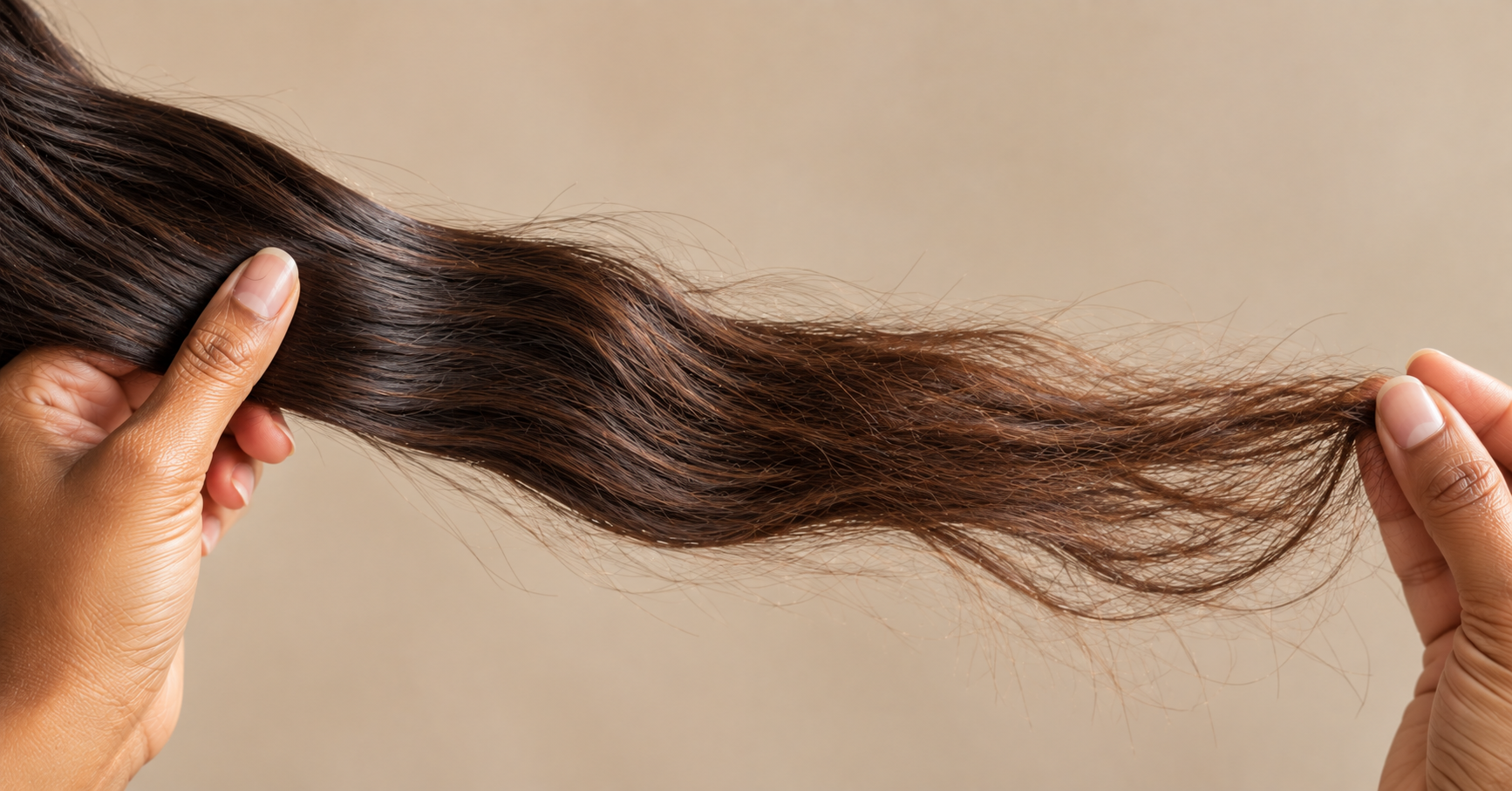
Hair grows from the scalp. The hair closest to your scalp is new. It has been washed a handful of times, brushed a handful of times, and has seen very little sun. The hair at your ends may be two, three, five years old. It has been through hundreds of washes, thousands of brush strokes, every summer you have had since it grew, and every chemical service in that window.
Those are not the same material. They will never behave the same way. The newer hair near the scalp is measurably less porous; the ends are more porous, and the difference grows with length. This is not a fringe position. The New York Society of Cosmetic Chemists states plainly that porosity varies along the length of the fiber and that a single head routinely holds a mixture of low, normal, and high porosity hair at once.[6]
A test that samples a single strand and reports a single answer cannot see this. It is not that the float test is imprecise. It is that the question it answers, what is my porosity, is not a question with one answer.
What I noticed on my own head
My ends were bleached. My crown was virgin hair that had never been touched. They behaved like two completely different heads of hair, and for a long time I thought that meant I was doing something wrong.
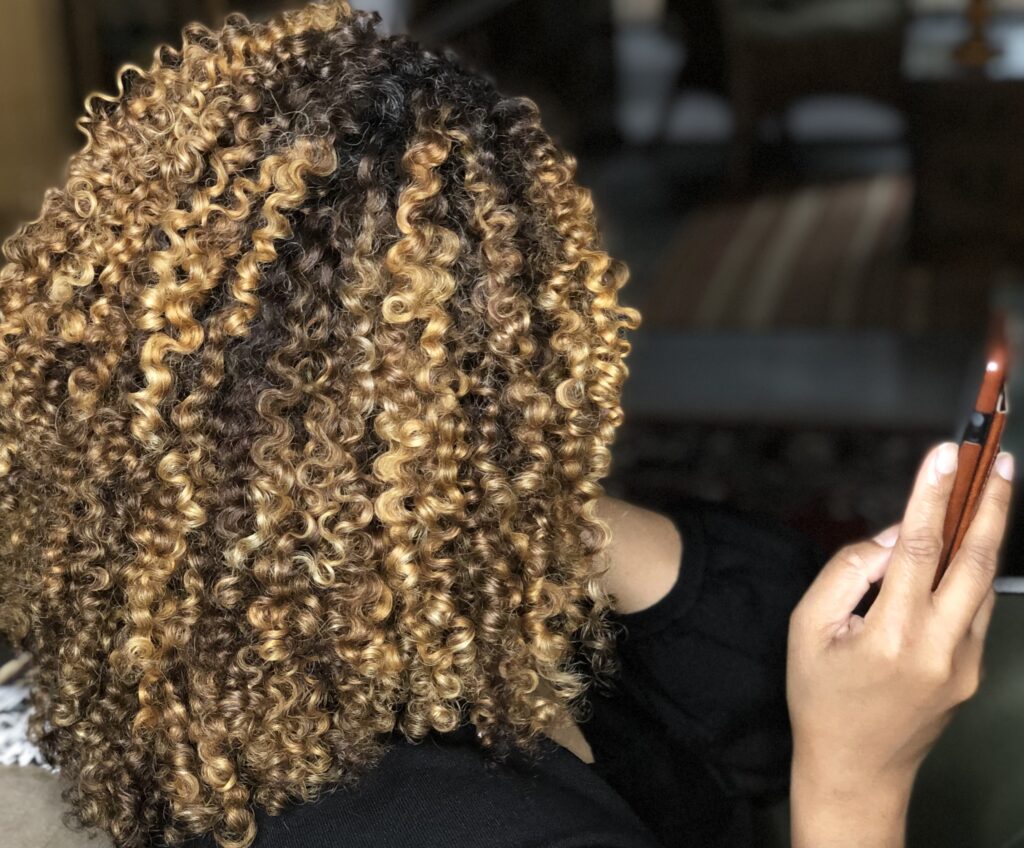
Product went into the bleached lengths almost instantly and seemed to disappear. The same product on my crown sat on the surface and took much longer to do anything at all. No chart accounted for that. Every guide wanted me to pick one porosity and apply one routine from root to tip, and my hair was flatly refusing to cooperate with that instruction.
It was not refusing. It was telling me something true, and I did not yet have the framework to hear it.
A better observation than any test
If you want evidence of the gradient on your own head, you do not need a glass of water. Wash your hair and let it air dry without touching it. Then pay attention to which parts finish drying first.
On most heads with any length or history, the roots dry first and the ends stay damp longest. That is the gradient made visible. The more damaged ends have lost more of their water repellent surface, so the surface itself becomes water loving, takes on more water, and holds onto it longer.[7] This is worth pausing on, because it is the opposite of what most porosity content tells you. You will read constantly that high porosity hair dries fast. Measured at the surface, damaged hair holds hydration water more tightly, not less.[7]
It is free, it uses your actual head rather than one shed strand, and it tells you something a float test never can: not a label, but a map.
What causes high porosity hair
Porosity rises through damage. The usual contributors:
- Chemical services. Bleaching, permanent color, relaxers, and perms alter the fiber structurally and permanently. Bleach is the heaviest hitter, and the damage registers within the first minute of processing.[2]
- Heat styling. Repeated flat ironing, curling, and high heat drying lift and fracture cuticle cells, especially without a heat protectant.
- Mechanical handling. Combing and brushing gradually wear down the cuticle scales.[8] Damage is greatest closest to the ends, which is exactly where the fiber is already oldest.
- Wet handling specifically. Water acts as a plasticizer inside the fiber, lowering its stiffness and causing it to break at a much lower stress than dry hair.[9] Wet hair is genuinely weaker hair.
- UV and environment. Sun exposure lifts and erodes the outermost cuticle layer and oxidizes the protective surface lipids.[5][6] So do saltwater and chlorine.
- Repeated wetting and drying itself. Each cycle of swelling and de-swelling stresses the cuticle, which is the mechanism behind what the curly community calls hygral fatigue.[6]
- Time. Even with careful handling, the ends of long hair have simply been alive longer.
Genetics gets cited a great deal in porosity content, usually as a way of telling readers their high porosity is innate and permanent. Baseline differences between people do exist, as noted above.[3][4] But the overwhelming majority of what gets diagnosed as high porosity is acquired, not inherited, and that distinction matters because acquired damage has causes you can act on.
The part of my history that explains all of it
I got my first relaxer at eleven, and that started a cycle that ran for years. Relaxers every few weeks. Then red color, then highlights, then bleach, sometimes just weeks after a relaxer. Dominican blowouts. Flat ironing almost every week, often skipping heat protectant because I could not be bothered with the extra step.
My hair did what abused hair does. It broke. I would watch it snap off, cut away the damage, slick what was left into a bun under a heavy coat of coconut oil, and tell myself I was healing it, until it looked good enough to start the whole cycle again. For years my hair could not grow past my upper back before I had to chop it and begin again. Eventually it thinned enough that I started wearing clip in extensions to hide how much I had lost. I genuinely thought I was going to go bald.
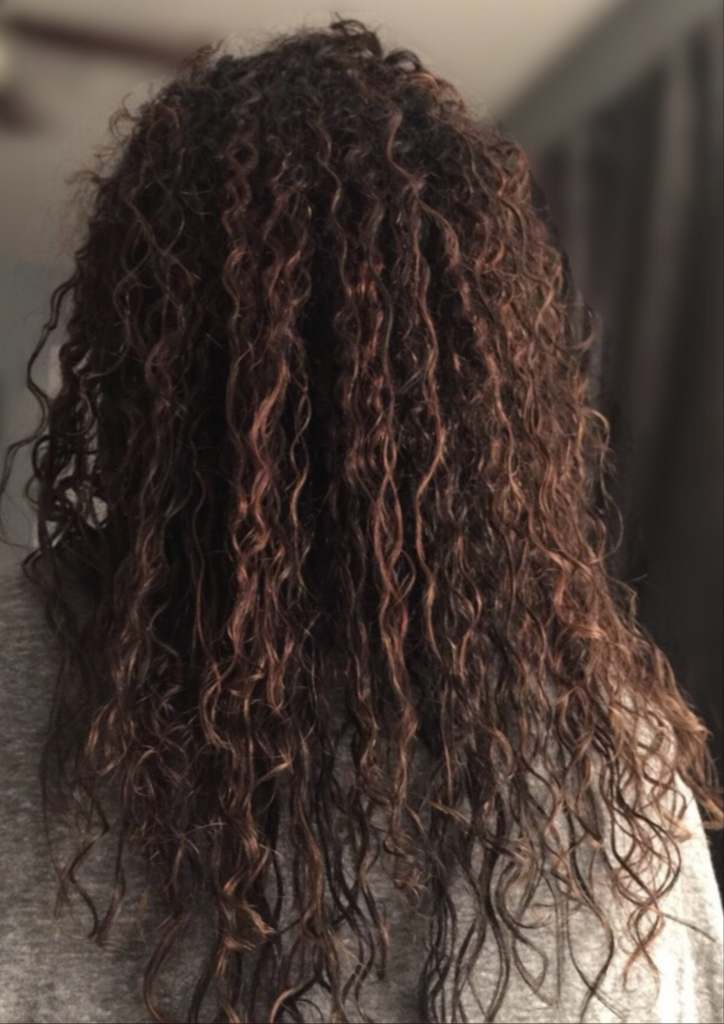
In May of 2016 I decided I was done. I put down the flat iron and the chemicals and started documenting whatever happened next, and I waited to see what my hair would do if I stopped fighting it.
I did not have high porosity hair. I had badly damaged hair, and high porosity was the readout.
The moment the rules stopped adding up
Here is the part I want people to sit with, because it is the reason I no longer teach porosity as a set of rules.
The constant complaint in my hair life was dryness. That is why the Curly Girl Method felt like a revelation at first. My hair was severely damaged and breaking, and a method built around gentleness and conditioning genuinely helped at the start.
But the high porosity playbook I had absorbed said my hair was thirsty, so the answer was more water and more moisture, constantly. So I kept it wet. I refreshed it wet, I kept it drenched in coconut oil, and when my hair felt weakest, which was when it was wet, I read that as proof it needed even more.
It was not thirsty. It was waterlogged.
Hair swells when it takes on liquid water. Water works as a plasticizer inside the keratin network, reducing the fiber stiffness and dropping the stress at which it fractures.[9] High water content does not make hair more resilient. It makes it more vulnerable to breakage while it is in that state, and each swelling and de-swelling cycle stresses the cuticle further.[6] My hair felt fragile when wet because it genuinely was, and the more time it spent saturated, the more damage that cycle did. That is hygral fatigue, and I gave it to myself by following high porosity advice correctly.
That is the failure worth naming. It was not that I did the routine badly. The routine was built on a wrong model, and doing it faithfully made things worse.
The moisture problem underneath all of this
Most porosity advice rests on an idea that does not survive contact with the science: that your products control how much water your hair holds, and that more water is better.
They do not, and it is not.
The water content of dry hair is governed overwhelmingly by the relative humidity of the air around it. Hair continuously exchanges water vapor with its environment, and that exchange is what sets its water level. The relationship was first mapped in 1931 and re-measured with modern instrumentation eighty years later, and the two curves agree.[10][11] At around fifteen percent humidity hair holds roughly five percent of its weight in water; at eighty percent humidity, around seventeen percent.[11] Your leave in cannot override the weather.
There is also a counterintuitive finding worth knowing: when researchers compared consumer perception of moisturization against actual measured water content, the two did not track each other.[12] Hair described as feeling more moisturized was not the hair holding more water. Which makes sense once you understand the mechanism. Damaged hair has more affinity for water, water swells the fiber and lifts the cuticle, and a lifted cuticle feels coarse.
So what are conditioners actually doing? Hair carries negative charge along its surface, and damaged hair carries more of it. Conditioning agents are built the opposite way, with a positively charged head and a long fatty tail. The head binds to the negative sites, the tail lies flat against the fiber, and the result is a smoother surface with much lower friction between strands.[1][13] That soft, slippery result is a conditioned feel, not a stored quantity of water. Products described as moisturizing or hydrating are, in practice, conditioning products, and that is genuinely good. It is just not what the label says.
Is low porosity hair a problem?
No. This is the shortest section in the article and it is one of the most important.
Low porosity means your cuticle is lying flat and intact. It is doing precisely what a cuticle is for. There is nothing to open, nothing to correct, and nothing broken to fix.
An entire content category exists around low porosity problems, built on the premise that a healthy cuticle is an obstacle standing between you and the products you paid for. That premise gets the situation exactly backwards. Most hair care ingredients are not supposed to get inside the fiber; they work by sitting on the surface, and the surface is where the smoothness, the shine, and the protection come from.[11][14] If products sit on the surface and feel heavy, the useful conclusion is that those particular products are not right for your hair, or you are using more than your hair needs. It is not that your hair is malfunctioning.
You will also see advice to open the cuticle with heat or steam before conditioning, and to close it afterwards with a cold rinse. Cuticles do not open and close like doors. They lie flat, or they are lifted, and lifted means damaged. A cold rinse does not close anything. If your hair feels smoother after conditioning, that is the conditioning agents doing their job on the surface.
Is there a hair porosity chart?
There is, and it is worth looking at once so you can see exactly why this article does not use one.
The chart circulating online almost always looks the same: three columns, low, medium, and high, each with a tidy list of traits. Low porosity hair takes a long time to get wet, resists color, and does well with light products. High porosity hair gets wet instantly, grabs color fast, and needs heavy, protein-rich products. Somewhere in the middle sits medium, described as the easiest to manage of the three.
The chart is not fabricated. Each individual trait in it is loosely true of hair at that end of the damage spectrum. The problem is the structure around those traits, not the traits themselves.
A chart implies three boxes and a hair that belongs in one of them permanently. What you actually have is a spectrum with a gradient running from your roots to your ends, described in detail earlier in this article, and a chart has no way to draw that. It also implies the traits move together as a set, so a hair described as high porosity is assumed to have all of the high porosity column at once. Real heads mix and match: hair can dry quickly at the surface while still being genuinely low in cuticle damage, or feel slow to wet while being moderately weathered. The columns are a simplification of a simplification.
So if you found this page looking for a chart, here is the honest version. Take the three columns you have seen, and replace them with one line sliding from intact to damaged. Everything the chart told you is still roughly true, it just does not stop at three stations, and your own head is very likely sitting at more than one point on it depending on where you measure.
Porosity across straight, wavy, curly, and coily hair
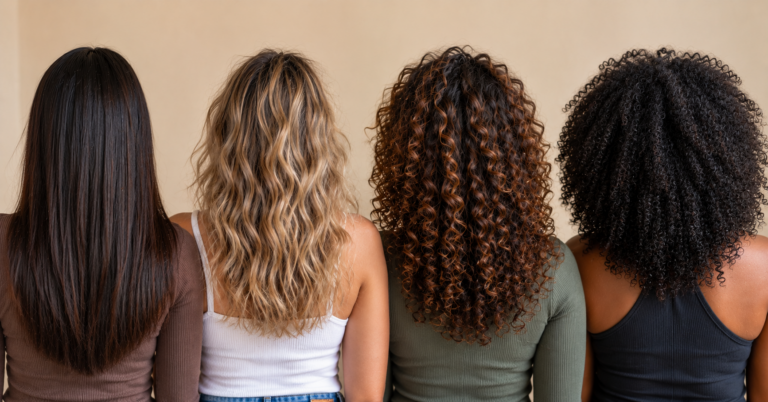
Porosity is a property of the fiber, and the fiber is fundamentally the same across all four. The genuine difference between straight, wavy, curly, and coily hair is the shape of the strand and the pattern it grows in. What changes is not the mechanism, but where the damage tends to concentrate and how it announces itself.
Straight hair
Damage tends to show as dullness, faster color fade, split ends, and stringy or wispy ends while the lengths still look fine. Because there are fewer bends, sebum travels down the shaft more easily, so the ends are somewhat better protected than they are on curlier hair. The gradient is still there; it just declares itself later.
Wavy hair
Damage often shows up as a loose or inconsistent pattern, halo frizz around the crown, and sections that behave differently from one another on the same head. Wavy hair is also the texture most easily overloaded, so heaviness gets misread as low porosity when it is often just too much product for a fine fiber.
Curly hair
Damage tends to show as loss of definition, particularly at the ends, plus tangling and single strand knots. Every bend in a curl is a point where the cuticle sits less evenly and where a comb catches, so curly hair accumulates mechanical damage faster along the length than straight hair does.[3]
Coily hair
Coily hair has the most bends per inch, which means the most points of mechanical vulnerability, and sebum has the hardest journey down the strand. Damage tends to show as breakage, shortened apparent length, and roughness rather than as a change in curl definition. The root to tip gradient is usually steepest here, which is precisely why zoned handling matters most for coily hair.
What none of these justify is a different underlying model. Nobody needs a separate science. What differs is where you look for the evidence.
What actually helps, whatever your porosity
This is the part that frustrates people, because it is far less exciting than a porosity chart. The honest answer is that the useful actions are largely the same across the spectrum, and they are about protection and conditioning rather than diagnosis.
- Condition after every wash, before you brush or detangle. Shampoo leaves hair more negatively charged, strands repel each other, friction climbs, and that friction is what wears the cuticle down. Conditioners carry positively charged ingredients that neutralize that charge and reduce friction.[1][13]
- Never comb or brush dry, unconditioned hair. If you are touching up dry hair with a brush, put something on it first, even a little oil.[8]
- Handle wet hair as little as you can. It is measurably weaker wet, and each saturation cycle adds stress.[9][6]
- Be gentlest with your ends, because that is where the accumulated damage already is and where combing does the most harm.[8]
- Use a heat protectant every single time. This is the cheapest damage prevention available.
- Protect against UV if you spend real time in the sun.[5]
- Judge a conditioner by what it does, not by its ingredient list. If it detangles your hair and leaves it feeling smooth, it is working. If it does not, try another one. Two products with the same ingredients in different ratios perform completely differently, so a label cannot tell you the answer in advance.
If your hair is bleached or chemically damaged, a conditioner formulated for damaged or bleached hair is worth choosing deliberately. Damaged hair carries more negative charge, so positively charged conditioning ingredients deposit onto it more readily, and formulas built for that hair state tend to be designed around it.[1][13]
Can you fix high porosity hair?
Not in the sense the word fix implies, and you deserve a straight answer about this.
Cuticle cells that have been cracked, worn away, or stripped do not regrow. The cortex, which is the part of the fiber responsible for strength, is not rebuilt by conditioning products. Larger protein molecules cannot get into the cortex at all and work by adsorbing to the surface as a film; the smaller hydrolysed fragments that can penetrate do so in limited amounts and with limited effect on the structure underneath.[14] Conditioning agents attach to the surface, fill gaps, smooth the fiber, and temporarily flatten lifted scales. That is real, valuable work, and it makes hair behave and feel dramatically better. It is also temporary, and most of it comes off at the next wash.
So the honest position is this. You cannot undo damage. You can make damaged hair look, feel, and behave far better, you can slow further damage substantially, and you can grow healthier hair from the scalp and protect it better this time. Over a long enough horizon, the damaged material moves down and off your head.
You will see claims that repeated protein and conditioning treatments convert high porosity hair back to low porosity. Treat that carefully. Measurable improvements in feel, shine, and combing strength are genuine. Structural restoration of a damaged cortex is not what is happening.[14]
What to observe on your own head this week
If you take one practical thing from this article, make it this. Instead of trying to determine your porosity, gather evidence about your own hair. Three observations, no equipment, one week.
1. Drying order.
Wash, air dry untouched, and note which sections finish first and which stay damp longest. You are mapping where your damage is concentrated.
2. Wet feel versus dry feel.
Notice how your hair feels while saturated compared with once it is dry. If it feels notably weak, stretchy, or mushy wet, that is worth knowing, and it is a signal to spend less time saturated and to handle it less in that state.
3. Response to one change.
Change exactly one thing. One product, one step, one variable. Then give it two to four wash days before you judge it. Most people change four things at once and then cannot tell which one did anything, which is how you end up with a bathroom full of products and no information.
That third habit is the entire method in miniature. Your hair is not like anyone else’s, in the same way that a diet that works beautifully for one person does nothing for another. You are looking for your own hair’s diet, and the only way to find it is to test one variable at a time and pay attention.
This is what changed things for me. Not a better product. I stopped following influencers, general blogs, and prescribed schedules for people with high porosity hair, and I started learning the actual science alongside a friend who is a cosmetic formulator with a PhD in chemistry. The moment I learned to read what my hair was telling me is the moment it started thriving. It came through science and through trial and error, in that order.
| IF YOU WANT TO RUN THIS PROPERLY One change, two to four wash days, written down. That last part is where most people lose the thread, because two weeks later nobody remembers what the weather was doing or how much product went on. A notes app or a scrap of paper is enough. Write down what you changed, the date, and how your hair felt, and you will have something to read back instead of a guess. |
Frequently asked questions
Why does my hair act low porosity some days and high porosity others?
Because you do not have one porosity, and because the environment changes. Different zones of your head are in different condition, and the humidity around you shifts how your hair behaves week to week.[10][11] Both things are normal and neither means you mis-tested.
Does high porosity hair dry faster or slower?
Slower, at the surface, which is the opposite of what most articles say. Damage strips the water repellent outer layer, leaving a surface that attracts water and holds onto it.[7] That is why your ends stay damp after your roots are dry. If you have been told high porosity hair loses water fast and therefore dries fast, that claim is doing two things at once and getting both muddled.
Should I avoid protein if I have low porosity hair?
No. Proteins are one type of conditioning agent among several, and the larger ones behave like any other surface film former.[14] If hair feels stiff or brittle after a protein product, the usual explanation is that the product was mostly protein and short on other conditioning ingredients, so the hair is under-conditioned rather than overloaded.
Do I need to balance moisture and protein?
There is no scale to balance. What hair needs is conditioning and less damage. If your hair feels bad, the question is whether it is well conditioned and how it is being handled, not which side of an imaginary seesaw you landed on.
Is a lab porosity test worth it?
Laboratory methods can measure porosity properly, using gas sorption to quantify pore volume and surface area directly, and consumer services offering this do exist.[2] Whether that is worth your money depends on whether a number would change what you do. For most people it would not, because the actions that follow are the same either way.
Does cold water close the cuticle?
No. Cuticles cannot open and close. A lifted cuticle is a damaged one, and only a conditioning agent can temporarily flatten it.[1]
Is curly hair automatically high porosity? Is straight hair automatically low porosity?
No, and this is one of the most common mix-ups on the topic. Curl pattern is the shape a strand grows in. Porosity is the condition of that strand’s surface. They are independent. A curly head that has never been colored or heat styled can sit at low porosity, and straight hair that has been bleached repeatedly can sit at high porosity. Curlier hair does tend to accumulate damage a little faster over time, for the geometric reasons covered above, but that is a difference in typical exposure, not a rule that ties texture to porosity.
What does it mean that healthy hair is hydrophobic?
It means intact hair is naturally water repellent at the surface, the same way a duck’s feathers shed water, because of a thin fatty layer on the outermost cuticle.[1] That is a feature, not a flaw: it is part of what keeps healthy hair smooth and helps it dry. Damage strips that layer, which is why damaged hair becomes hydrophilic instead, taking up water more readily. Porosity is, in large part, a way of describing where a given strand sits on that hydrophobic-to-hydrophilic line.
Does high porosity hair need protein?
Not automatically, and not because of its porosity specifically. Protein is one conditioning ingredient among several, and whether a given head responds well to it depends on the individual formula and how damaged the hair actually is, not on a porosity label. The full explanation of what protein does, why the classic protein-overload warnings usually describe something else, and how to tell whether your hair is one of the ones that benefits, lives in its own article.
Can porosity change back?
The behavior can improve a great deal. The structure does not return. Conditioning agents genuinely reduce friction, improve combing, and make the fiber feel and look better, but they act on the surface and they wash off.[13][14] What permanently lowers your average porosity is new growth replacing damaged length over time.
Where to go next
Understanding the model is the first half. Applying it to your specific head is the second half, and that takes structure rather than another article.
I am building a set of guides that do exactly that, for curly, straight, and gray hair. They are not out yet, but they are coming.
Let your hair be your guide.
Verna
References
1. Robbins, C. R. (2012). Chemical and Physical Behavior of Human Hair (5th ed.). Springer.
2. Hessefort, Y. Z., Holland, B. T., & Cloud, R. W. (2008). True porosity measurement of hair: a new way to study hair damage mechanisms. Journal of Cosmetic Science, 59(4), 303-315.
3. Cloete, E., Khumalo, N. P., & Ngoepe, M. N. (2019). The what, why and how of curly hair: a review. Proceedings of the Royal Society A, 475(2231), 20190516.
4. Coderch, L., Sabatier, L., Pasini, I., Alonso, C., Marti, M., & Baghdadli, N. (2025). Role of lipids in water permeation of different curl pattern hair types. Cosmetics, 12(5), 193.
5. Richena, M., & Rezende, C. A. (2015). Effect of photodamage on the outermost cuticle layer of human hair. Journal of Photochemistry and Photobiology B: Biology, 153, 296-304.
6. Evans, A. O. (2020). An Overview on Hair Porosity. New York Society of Cosmetic Chemists Scientific Blog, 11 November 2020.
7. Chikami, S., Maeda, S., Latag, G. V., et al. (2024). Analysis of the hydration water on the surface of human hair using a combination of infrared absorption vibrational spectroscopy and multivariate curve resolution. Surface and Interface Analysis.
8. Weiand, E., Rodriguez-Ropero, F., Roiter, Y., Angioletti-Uberti, S., Dini, D., & Ewen, J. P. (2025). Understanding and controlling the friction of human hair. Advances in Colloid and Interface Science, 345, 103580.
9. Yu, Y., Yang, W., Wang, B., & Meyers, M. A. (2017). Structure and mechanical behavior of human hair. Materials Science and Engineering: C, 73, 152-163.
10. Chamberlain, N., & Speakman, J. B. (1931). Uber Hysteresiserscheinungen in der Wasseraufnahme des Menschenhaares. Zeitschrift fur Elektrochemie, 37, 374.
11. Evans, T. A. (2012). Adsorption properties of hair. In T. Evans & R. Wickett (Eds.), Practical Modern Hair Science (pp. 333-365). Allured Business Media.
12. Davis, M. G. (2014). Moisture vs. moisturization: understanding the consumer benefit. Presented at the TRI Princeton 5th International Conference on Applied Hair Science.
13. Baruah, S., et al. (2015). Lamellar gel phase formation in cationic surfactant and fatty alcohol systems. Chemical Engineering Science, 131, 146-154.
14. Malinauskyte, E., Shrestha, R., Cornwell, P. A., Gourion-Arsiquaud, S., & Hindley, M. (2021). Penetration of different molecular weight hydrolysed keratins into hair fibres and their effects on the physical properties of textured hair. International Journal of Cosmetic Science, 43(1), 26-34.