The Dryness Myth: Why Your Hair Isn’t Thirsty, It’s Under-Conditioned
If you have ever used every hydrating product on the shelf and your hair still feels dry, you have probably concluded that your hair needs even more moisture. Richer conditioner. A heavier oil. A humectant-packed leave-in, applied more often.
I want to stop you before you buy the next thing, because I did this for years and it made my hair worse, not better.
Hair does not run out of water the way a plant does. It cannot be topped up like a tank. And the feeling you are calling dryness, rough, dull, tangled, hard to manage, is very often not a lack of water at all. It is a lack of conditioning, and sometimes it is the opposite problem entirely: too much water, held against the fiber for too long.
This article explains what dryness actually is, why the standard advice can make it worse, and what to do instead, whatever your hair type and whatever you have been told your porosity requires.
| THE SHORT ANSWER The water content of your hair is set mostly by the humidity in the air, not by the products you apply. So “adding moisture” is not really something a product can do in any lasting way. What conditioner actually does is smooth the surface and reduce friction, and that is what makes hair feel soft, manageable, and shiny; call it conditioning, because that is what it is. The rough, dry feeling usually means the hair is under-conditioned or its surface is worn. In some cases it means the opposite: the hair has been kept wet too often and has been weakened by repeated swelling. Both look like “dryness.” Neither is fixed by more water. |
What “dry hair” actually is
Start with the word itself, because it is doing a lot of misleading work. Dry implies a deficit of water, the way dry soil lacks water. But the water content of hair is governed overwhelmingly by the relative humidity of the surrounding air, not by how much product you apply. Hair continuously exchanges water vapour with its environment, a relationship first mapped in 1931 and confirmed with modern instruments decades later.[1][2] At low humidity hair holds a small percentage of its weight in water. At high humidity it holds considerably more, regardless of what is on it.[2]
So the sensation you are calling dryness is almost never a literal water shortage. What you are actually noticing is the condition of the cuticle, the outermost layer of the hair. When it lies flat and smooth, hair reflects light evenly and feels soft, because there is little friction between strands. When it is roughened, lifted, or worn, hair scatters light, catches on itself, and feels exactly like what people describe as dry.[3]
There is also a genuinely counterintuitive finding worth knowing. When researchers compared how moisturised people perceived their hair to be against how much water it actually contained, the two did not track together.[4] Hair that felt more moisturised was not the hair holding more water. Feeling hydrated and being hydrated are different measurements, and the industry sells you the feeling while using the language of the measurement.
Why the low-porosity and high-porosity split is itself part of the problem
Most moisture advice, including advice this site has previously given, splits readers into two camps and hands each one a different shopping list. Low-porosity hair supposedly needs light humectants and almost no oil. High-porosity hair supposedly needs a concentrated cocktail of humectants, proteins, and heavy sealants, because it is “thirsty” and losing water constantly.
Porosity is not two fixed hair types. It is a damage spectrum, and most heads carry a mix of it along a single strand, with newer growth behaving differently from older, more weathered length. Treating porosity as a category you belong to, rather than a condition your fiber is currently in, is the exact error this site’s porosity pillar exists to correct, and it is worth reading if you have not.
What that means here is straightforward. There is no separate playbook for low-porosity dryness and high-porosity dryness, because the underlying problem is the same in both cases: a surface that is not adequately conditioned, or, in a meaningful number of cases, hair that has been kept wet more than it can tolerate. What differs is degree, not category.
Why “adding moisture” does not work the way it is sold
The standard model treats moisturising as a two-step process: get water molecules into the strand, then seal them in with an occlusive layer so they cannot escape. Layer a humectant, then layer an oil on top, and repeat.
Two problems with this. First, as covered above, the water content of the strand is set by ambient humidity, not by what you put on it, so there genuinely is not a store of water sitting in your hair for a product to seal in.[1][2] Second, cuticles do not open and close like doors that a product can hold shut. They lie flat, or they are lifted, and lifted means damaged or swollen, not unsealed.[3] A heavy oil layered on top does not close anything. It sits on the surface as a film.
None of which means those products are useless. It means they are doing something different from what the label implies.
Conditioning agents, the ingredients actually responsible for smoother, softer, shinier hair, work by binding to the surface of the strand and reducing friction between strands. Hair carries a negative surface charge, more so where it is damaged, and conditioning agents are built the opposite way, with a positively charged head and a long fatty tail. The charged head binds to the negative sites, the tail lies along the fiber, and the result is a smoother surface with far less friction.[3][5] Oils and butters add slip and shine through a similar surface effect. That is genuinely valuable work. It is conditioning, not hydration, and the distinction matters because it tells you what to actually judge a product on: how it makes your hair behave, not how much water it claims to deliver.
Protein is not a moisturiser either
Both of the posts this pillar replaces described protein as a moisturising ingredient, on the logic that its water-binding amino groups add hydration alongside strengthening the fiber.
Protein is a conditioning agent, the same category as the ingredients above, and a fairly ordinary one at that. It mostly sits on the surface as a film, or in the case of smaller hydrolysed fragments, penetrates in limited amounts with a modest effect on strength. It is not a superior water-delivery system, and treating it as a second moisturizing lever alongside humectants, to be dosed up for high porosity and dosed down for low porosity, revives a model that does not hold up. This site has a full explanation of what protein actually does and why the classic protein-overload warnings are usually describing something else entirely.
What I did, and why it made things worse
The years my hair was most damaged were also the years I was most convinced it was thirsty. It had been through relaxers starting at eleven, then color, then bleach, then near-weekly flat ironing, and the constant complaint was dryness. So when I found the Curly Girl Method, its central promise, that dry, damaged curls just needed moisture and the right hold, felt like it had been written for me specifically.
I kept my hair wet. Refreshed it wet, restyled it wet, drenched it in coconut oil, and treated any dry moment as a failure to correct immediately. When my hair felt at its weakest, and it did feel weakest while it was wet and saturated, I read that as proof it needed still more moisture. I was doing exactly what I had been told to do, faithfully, and my hair kept getting worse.
It was not thirsty. It was waterlogged.
Water genuinely does make hair more flexible, by temporarily loosening the hydrogen bonds holding the fiber’s shape, which is why wet hair stretches further than dry hair.[6] But that flexibility comes at a cost: wet hair is also measurably weaker, and each cycle of swelling while wet and shrinking while it dries stresses an already-damaged cuticle further.[6][7] Do that constantly, which is precisely what I was doing, and you get what the curly community calls hygral fatigue: hair that has been so repeatedly saturated it becomes soft, overstretched, and prone to snapping, all while looking and feeling exactly like the dryness it was supposed to be curing.
I gave myself hygral fatigue by following moisture-first advice correctly. That is the part I want people to sit with, because the failure was not a lack of discipline. The model itself was pointing me in the wrong direction.
The saturation check: find out which problem you actually have
Before changing a single product, this costs nothing and takes one wash day.
- Wash and condition as you normally would. Note how your hair feels once it is fully dry: rough, dull, and stiff points toward under-conditioning. Soft, weak, and stretchy, especially right after washing, points toward too much water contact rather than too little.
- While your hair is wet, gently stretch a single strand between two fingers. If it stretches a long way and feels rubbery or mushy before springing back weakly, that is a sign of water swelling the fiber past what it can comfortably handle, which is the hygral fatigue direction, not the dry direction.
- Count how often your hair gets fully saturated in a week: washes, co-washes, refreshing sprays, swimming. If that number is high and the rough feeling persists anyway, more water is not the missing variable.
If the check points toward under-conditioning, the fix is a genuinely better conditioning product, used consistently, not more of it. If it points toward hygral fatigue, the fix is fewer saturation events and richer conditioning agents rather than more water-based products, for a stretch of weeks, while the fiber recovers.
What actually helps
- Judge products by behavior, not by the word hydrating on the label. Does your hair detangle more easily, hold its shape longer, and break less? That is conditioning working. A product that only feels nice in the shower and nothing after is not doing much.
- Condition every wash, before you brush or detangle. Shampoo leaves hair more negatively charged and strands repel each other, raising friction and wear. Conditioner brings that charge back down.[3][5]
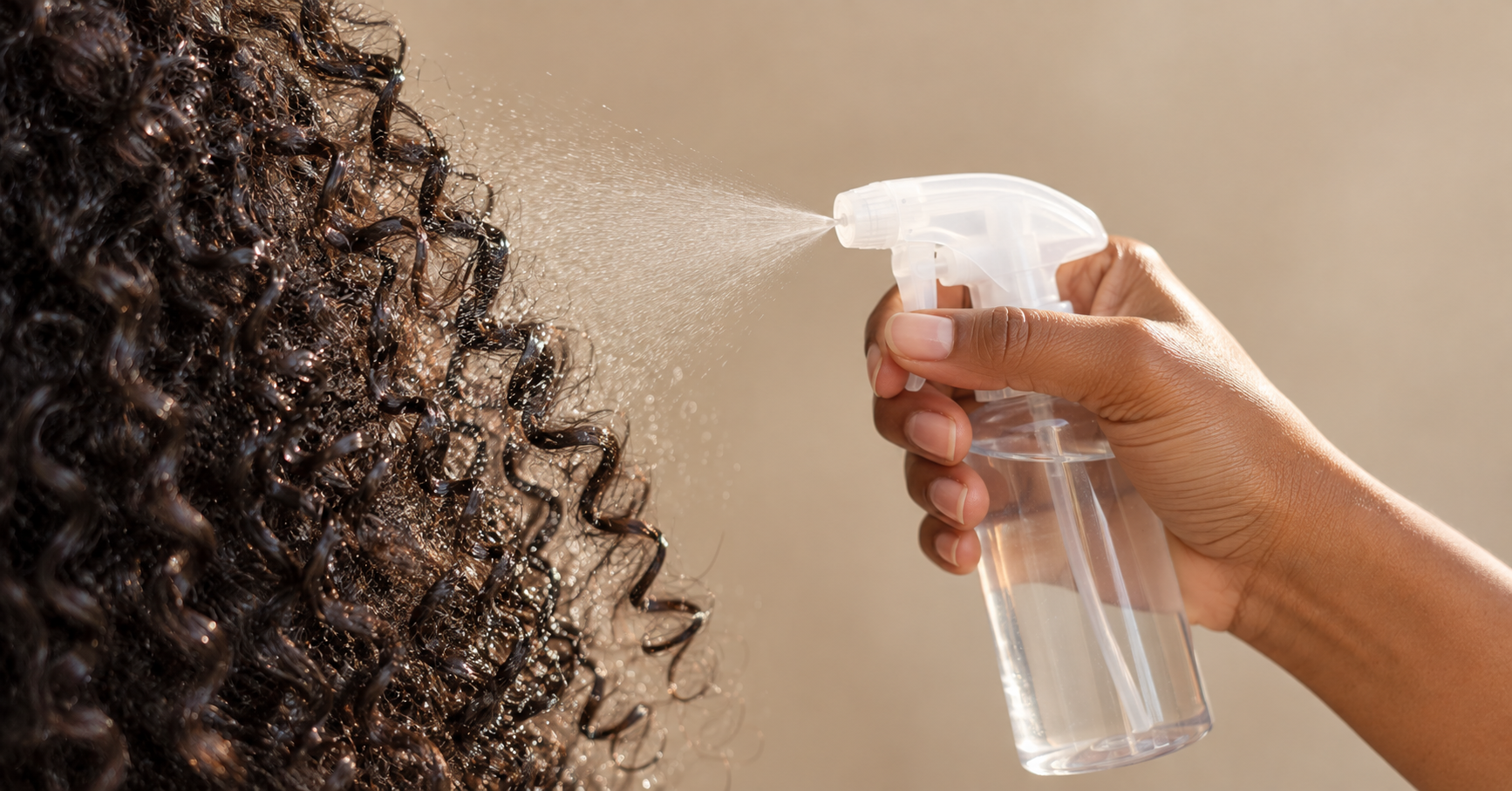
- Reduce saturation frequency if the check above points that way. Refreshing does not have to mean fully rewetting; a light mist plus a leave-in redistributes far less water than a full soak.
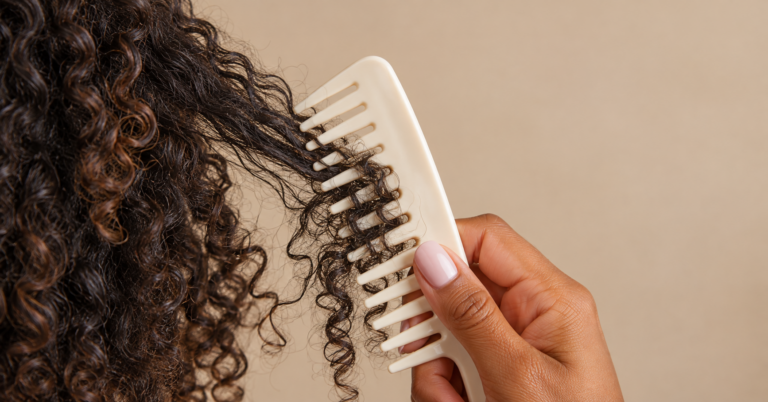
- Protect the surface you have. Heat protectant every time, gentler detangling, less aggressive brushing dry.
- Expect seasonal shifts. Since water content tracks humidity, the same routine can feel different in summer and winter, and that is the air changing, not your product failing.[1][2]
How this shows up on straight, wavy, curly, and coily hair
Same mechanism throughout. Presentation differs by how oil travels and how much surface area is exposed to handling.
Straight hair
Sebum travels the shaft easily, so straight hair is rarely genuinely under-conditioned at the roots, and the rough feeling usually concentrates at the ends. Heavy “hydrating” products often just weigh it down without addressing the actual surface issue.
Wavy hair
Sits in the hardest spot: enough surface area to need real conditioning, fine enough to be overloaded easily. The saturation check is worth running carefully here, since wavy hair is also prone to hygral fatigue from frequent refreshing.
Curly hair
Every bend is a place where the cuticle sits less evenly, so curly hair genuinely needs more conditioning support than straight hair. That is a real difference in need, not a reason to treat it as chronically thirsty.
Coily hair
Sebum has the longest journey and the most bends to travel past, so the ends are consistently the least conditioned part of the head. The gradient from root to end is usually steepest here, which is exactly why zoned conditioning, more at the ends, less at the roots, matters more for coily hair than any other texture.
Frequently asked questions
Why does my hair feel dry right after I wash and condition it?
Usually one of two things. The conditioner is not matched to what your hair needs, so it is not smoothing the surface enough. Or the wash itself, if it involved a long soak or very hot water, has left the fiber temporarily swollen and rough, which resolves as it dries.
Does drinking more water fix dry hair?
No. Hydration status affects your body broadly, but the water content of a strand of hair, which is dead tissue with no blood supply, is governed by ambient humidity, not by your fluid intake.[1][2]
Is low porosity hair naturally drier than high porosity hair?
No, and this question itself assumes the type model this article corrects. Low porosity generally means a smoother, less damaged cuticle, which is not a state of dryness. High porosity generally means more damage, which produces the rough feeling being discussed here, but through surface condition, not through an internal water deficit.
Should I use more oil if my hair feels dry?
Only if the saturation check points toward under-conditioning and your current products are not providing enough film-forming support. If it points toward hygral fatigue, adding more of anything wet or humectant-heavy will likely make it worse.
Can dry hair be permanently fixed?
If the roughness is from surface damage, no product reverses that structurally; you can dramatically improve how it feels and behaves, and the healthiest length will eventually be the new growth you protect going forward. If it is hygral fatigue, that is largely reversible by reducing saturation and conditioning well, since the fiber itself was not structurally destroyed.
Where to go next
Knowing the mechanism tells you what is actually happening. Building a routine around your specific hair, in your specific climate, is a system rather than one article.
I am building a set of guides that do exactly that, for curly, straight, and gray hair. They are not out yet, but they are coming.
Let your hair be your guide.
Verna
References
1. Chamberlain, N., & Speakman, J. B. (1931). Uber Hysteresiserscheinungen in der Wasseraufnahme des Menschenhaares. Zeitschrift fur Elektrochemie, 37, 374.
2. Evans, T. A. (2012). Adsorption properties of hair. In T. Evans & R. Wickett (Eds.), Practical Modern Hair Science (pp. 333-365). Allured Business Media.
3. Robbins, C. R. (2012). Chemical and Physical Behavior of Human Hair (5th ed.). Springer.
4. Davis, M. G. (2014). Moisture vs. moisturization: understanding the consumer benefit. Presented at the TRI Princeton 5th International Conference on Applied Hair Science.
5. Weiand, E., Rodriguez-Ropero, F., Roiter, Y., Angioletti-Uberti, S., Dini, D., & Ewen, J. P. (2025). Understanding and controlling the friction of human hair. Advances in Colloid and Interface Science, 345, 103580.
6. Yu, Y., Yang, W., Wang, B., & Meyers, M. A. (2017). Structure and mechanical behavior of human hair. Materials Science and Engineering: C, 73, 152-163.
7. Hessefort, Y. Z., Holland, B. T., & Cloud, R. W. (2008). True porosity measurement of hair: a new way to study hair damage mechanisms. Journal of Cosmetic Science, 59(4), 303-315.